
NCI-H3122
Cat.No.: CSC-C7077J
Species: Homo sapiens (Human)
Source: Pleural Effusion Metastasis
Morphology: Epithelial
Culture Properties: Adherent
- Specification
- Background
- Scientific Data
- Q & A
- Customer Review
NCI-H3122 is a well-characterized human non-small cell lung cancer (NSCLC) cell line established from the lung adenocarcinoma tissue of a 54-year-old Caucasian male patient. The cells exhibit an adherent, epithelial-like morphology with a doubling time of approximately 48.5 hours and are routinely cultured in RPMI-1640 supplemented with 10% fetal bovine serum.
The defining genetic hallmark of NCI-H3122 is the presence of the EML4-ALK fusion gene, resulting from a chromosomal translocation between echinoderm microtubule-associated protein-like 4 (EML4) and anaplastic lymphoma kinase (ALK). Specifically, this cell line harbors EML4-ALK variant 1, characterized by the fusion of EML4 exon 13 with ALK exon 20. These fusion drives constitutive oncogenic signaling and renders NCI-H3122 cells highly dependent on ALK activity-a phenomenon termed "ALK addiction".
NCI-H3122 serves as an indispensable preclinical model for investigating ALK-targeted therapies. The cells exhibit marked sensitivity to first-generation ALK tyrosine kinase inhibitors (TKIs), which effectively inhibits ALK phosphorylation and downstream AKT and ERK pathways. However, acquired resistance invariably emerges, and NCI-H3122 has been instrumental in elucidating resistance mechanisms. Notably, resistant variants derived from this line demonstrate activation of EGFR as a bypass signaling pathway in the absence of ALK secondary mutations, and combined ALK and EGFR inhibition has been shown to overcome this resistance. The line has also been used to generate resistant clones to next-generation ALK inhibitors such as ceritinib and alectinib.
Identification of ISZ-sTRAIL Protein as a Potent Anticancer Agent for EML4-ALK-Positive Non-Small-Cell Lung Cancer
EML4-ALK-positive lung cancer represents an important molecular subtype of non-small-cell lung cancer (NSCLC) that initially responds to ALK inhibitors but invariably develops resistance, highlighting the need for novel targeted therapeutic strategies. Death receptors DR4 and DR5 are frequently upregulated in malignancies and can selectively induce tumor cell apoptosis upon binding TRAIL. ISZ-sTRAIL, a trimer-stabilized soluble TRAIL fusion protein, exhibits potent antitumor effects via DR4/DR5 signaling activation. However, the expression status of DR4/DR5 in EML4-ALK-positive NSCLC cells and the therapeutic potential of targeting this pathway remain poorly defined.
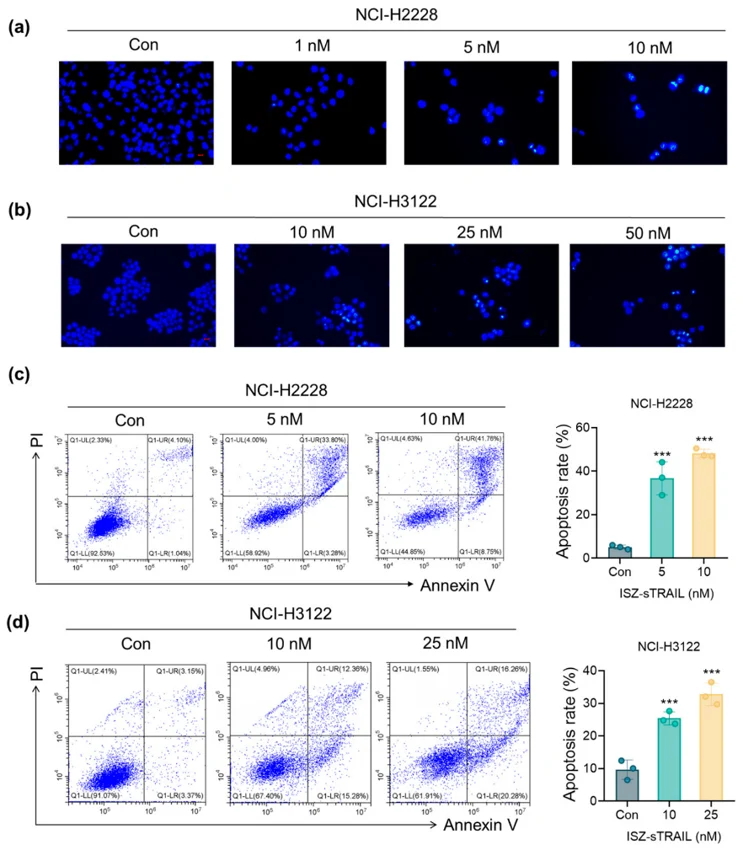
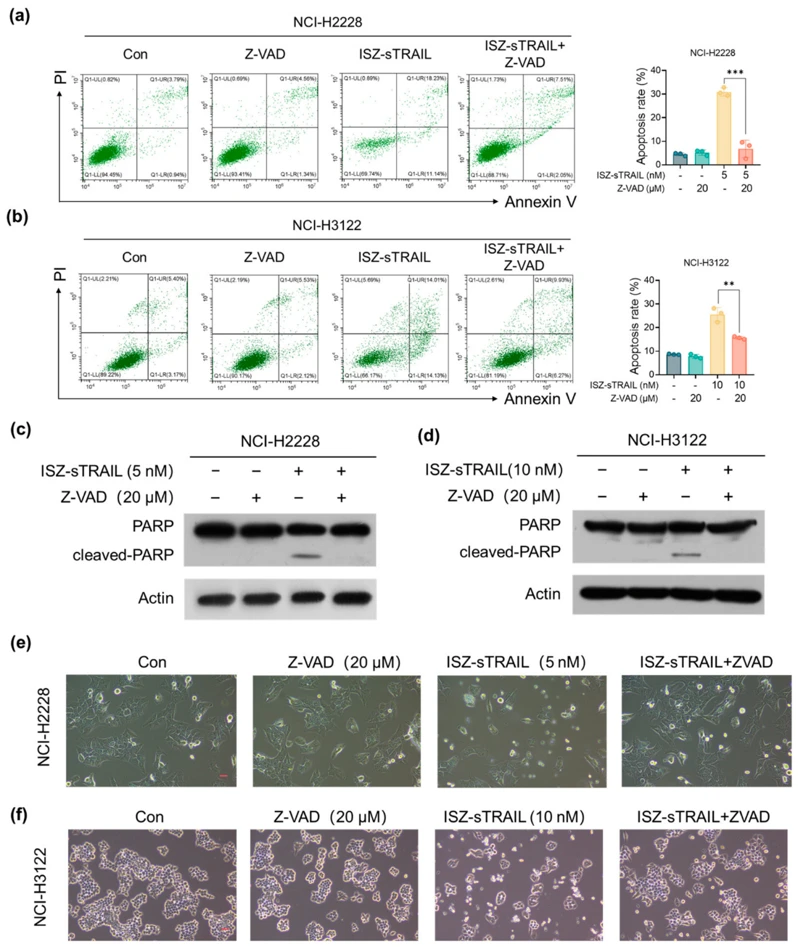
NCI-H3122 and NCI-H2228 are two commonly used cell lines representing ALK-rearranged NSCLC, each harboring distinct EML4-ALK fusion variants. Accordingly, these two cell lines were selected as models to investigate the anticancer activity of ISZ-sTRAIL protein. Our results showed that DR4 and DR5 were abundantly expressed in EML4-ALK-positive NCI-H2228 and NCI-H3122 cells compared with normal human bronchial epithelial 16HBE cells. Furthermore, ISZ-sTRAIL significantly suppressed the proliferation of NCI-H2228 and NCI-H3122 cells, while showing low cytotoxicity toward normal 16HBE cells. Moreover, ISZ-sTRAIL induced caspase-dependent apoptosis in both cell lines via activation of extrinsic and intrinsic pathway, and these effects were markedly abrogated by the pan-caspase inhibitor Z-VAD.
These findings identify DR4/DR5 as a potential therapeutic target and provide preclinical evidence for the development of TRAIL-based strategies in the treatment of EML4-ALK-positive NSCLC.
Ask a Question
Write your own review
Description: Lung small cell carcinoma producing insulin-like growth factor II. Cell growth is slow.
Description: Lung Cancer-1/squamous. Parent cell line of LC-1/sq-SF, the same patient as LC-F. Cell growth is slow.
Description: Species: human - male, 47 years old, CaucasianTumorigenecity: does not produce tumorsIsoenzyme: Me-2, 1-2; PGM3, 1-2; PGM1, 1; ES D, 2; AK1, 1; GLO-1, 1-2; G6PD, BHistopathology: carcinoma, ...
Description: Established in 1979 from the bone marrow aspirated from a 55-year-old white man with small cell lung carcinoma prior to treatment; corresponds to NCI-H209; described as expressing neuroendocrine ...
- Adipose Tissue-Derived Stem Cells
- Human Neurons
- Mouse Probe
- Whole Chromosome Painting Probes
- Hepatic Cells
- Renal Cells
- In Vitro ADME Kits
- Tissue Microarray
- Tissue Blocks
- Tissue Sections
- FFPE Cell Pellet
- Probe
- Centromere Probes
- Telomere Probes
- Satellite Enumeration Probes
- Subtelomere Specific Probes
- Bacterial Probes
- ISH/FISH Probes
- Exosome Isolation Kit
- Human Adult Stem Cells
- Mouse Stem Cells
- iPSCs
- Mouse Embryonic Stem Cells
- iPSC Differentiation Kits
- Mesenchymal Stem Cells
- Immortalized Human Cells
- Immortalized Murine Cells
- Cell Immortalization Kit
- Adipose Cells
- Cardiac Cells
- Dermal Cells
- Epidermal Cells
- Peripheral Blood Mononuclear Cells
- Umbilical Cord Cells
- Monkey Primary Cells
- Mouse Primary Cells
- Breast Tumor Cells
- Colorectal Tumor Cells
- Esophageal Tumor Cells
- Lung Tumor Cells
- Leukemia/Lymphoma/Myeloma Cells
- Ovarian Tumor Cells
- Pancreatic Tumor Cells
- Mouse Tumor Cells