
Immortalized Rat Embryonic Striatal (M213-2O) Cells-tsSV40T
Cat.No.: CSC-I9297L
Species: Rattus norvegicus
Source: Straitum
Morphology: Multipolar polygonal
Culture Properties: Adherent
- Specification
- Background
- Scientific Data
- Q & A
- Customer Review
Note: Never can cells be kept at -20 °C.
CIK-HT004 HT® Lenti-SV40 (tsA58 temperature sensitive mutant) Lentivirus Immortalization Kit
2) Test growth in permissive and non-permissive temperatures
Immortalized Rat Embryonic Striatal (M213-2O) Cells-tsSV40T are neuronal progenitor-like cells from embryonic striatal cells that have been made conditionally immortal through transfection with temperature-sensitive SV40 large T antigen (tsSV40T). Permissive conditions allow proliferation, while non-permissive conditions allow differentiation. tsSV40T will allow growth when cultured at a permissive temperature (typically 33°C). In this state the tsSV40T antigen is active and allows for prolonged proliferation and stable expansion of cells. At restrictive temperatures (non-permissive temperatures such as 37-39°C), SV40 T antigen function is decreased/inactivated which allows cells to arrest growth and differentiate. After differentiation cells display morphological and biochemical properties characteristic of striatal neurons such as neurite outgrowth and expression of neuronal markers such as βIII-tubulin, and microtubule associated protein.
Originating from striatal cells they may be used to study basal ganglia and striatum associated disorders including Huntington's disease, parkinsonian syndromes, and other movement disorders. In addition, this cell line can be used to examine neurotransmitter receptor signaling, calcium flux, oxidative stress, and neurotoxicity as well as screen neuroprotective agents. The cell line can also be used for functional analyses of genes within a neuronal lineage.
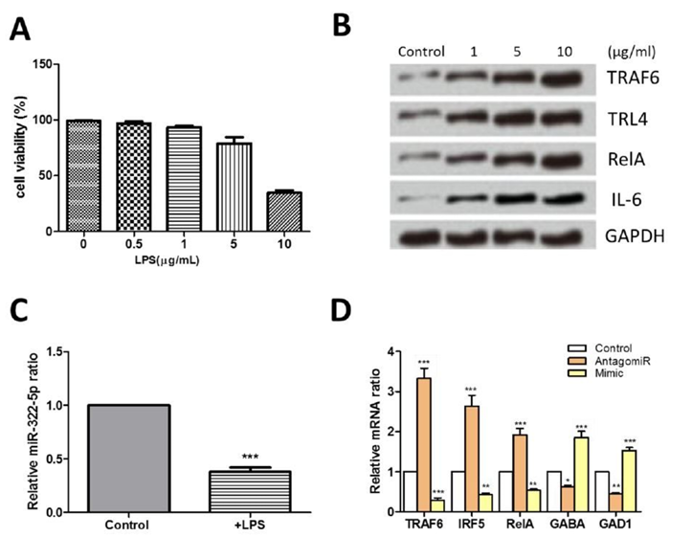
The LPS-Induced in Ammatory Circuit in Gabaergic M213-2O Cells Was Negatively Regulated by Mir-322 5p
MicroRNAs regulate gene expression post-transcriptionally, with some dysregulated miRNAs implicated in epileptogenesis. Zhou et al. investigated whether microRNA-322-5p modulates seizures and neuronal damage by targeting the NFκB-TLR4 inflammatory signaling pathway.
A pilocarpine-induced status epilepticus (SE) rat model was established, and hippocampal pathology was confirmed by immunohistochemistry. Next, they attempted to simulate the neuroin ammatory reactions by treating M213-2O cells with LPS. They found that LPS dose-dependently decreased the cell viability of M213-2O cells (Fig. 1A). Next, western blots of LPS-treated M213-2O cells demonstrated dose-dependent decreased expression of in ammatory markers including TRAF6, TRL4, RelA, and IL-6 (Fig. 1B). Consistently, the miR-322-5p level was signi cantly lower in LPS-treated M213-2O cells compared to their nontreated counterparts (Fig. 1C). Subsequently, they manipulated the level of miR-322-5p using antagomir (downregulation) and mimic (upregulation) molecules in M213-2O cells. Antagomir transfection led to the signi cantly increased expression of TRAF6 (its target), IRF5, and RelA, while decreased expression of GABA and GAD1 (Fig. 1D); this phenomenon was reversed in mimic-transfected M213-2O cells (Fig. 1D).
Ask a Question
Write your own review
Description: Immortalized Mouse Primary Artery Fibroblasts-GFP provided by Creative Bioarray have been developed by immortalizing mouse artery fibroblasts with SV40 Large T antigen and transfecting with tGFP. The ...
Description: Immortalized MHC II -/- Mouse Macrophage Cells (C2D) is derived from the knockout mice negative for MHCII molecule. They are stable in culture and survived through crisis in which they spontaneously ...
Description: The bone morphogenetic proteins (BMPs) produced by calvarial cells are crucial in osteoblastic differentiation and bone regeneration, however the limited lifespan of primary cells diminishes their ...

Description: The Immortalized Mouse Atrioventricular Cushion Mesenchymal Cells (tsA58-AVM) were derived from atrioventricular (AV) cushions of H-2Kb -tsA58 embryos at E9.5 and were conditionally immortalized in ...
Description: IDG-SW3 represent a non-homogenous population progressing from early osteoblasts to late osteocytic. These cells express functional SV40 large T antigen that is induced in the presence of IFN γ under ...
Description: The Immortalized Mouse Spleen Dendritic Cell (SRDC) line is functionally and phenotypically similar to dendritic cells; specifically, in its antigen presentation, T cell priming, and dendritic cell ...
- Adipose Tissue-Derived Stem Cells
- Human Neurons
- Mouse Probe
- Whole Chromosome Painting Probes
- Hepatic Cells
- Renal Cells
- In Vitro ADME Kits
- Tissue Microarray
- Tissue Blocks
- Tissue Sections
- FFPE Cell Pellet
- Probe
- Centromere Probes
- Telomere Probes
- Satellite Enumeration Probes
- Subtelomere Specific Probes
- Bacterial Probes
- ISH/FISH Probes
- Exosome Isolation Kit
- Human Adult Stem Cells
- Mouse Stem Cells
- iPSCs
- Mouse Embryonic Stem Cells
- iPSC Differentiation Kits
- Mesenchymal Stem Cells
- Immortalized Human Cells
- Immortalized Murine Cells
- Cell Immortalization Kit
- Adipose Cells
- Cardiac Cells
- Dermal Cells
- Epidermal Cells
- Peripheral Blood Mononuclear Cells
- Umbilical Cord Cells
- Monkey Primary Cells
- Mouse Primary Cells
- Breast Tumor Cells
- Colorectal Tumor Cells
- Esophageal Tumor Cells
- Lung Tumor Cells
- Leukemia/Lymphoma/Myeloma Cells
- Ovarian Tumor Cells
- Pancreatic Tumor Cells
- Mouse Tumor Cells