

Immortalized Mouse Podocytes-SV40 (MPC-5)
Cat.No.: CSC-I2320Z
Species: Mouse
Culture Properties: Adherent
- Specification
- Background
- Scientific Data
- Q & A
- Customer Review
and differentiating MPC cells express the WT-1 protein and an ordered array of actin fibres and microtubules extends into the forming cellular processes during differentiation, reminiscent of
podocyte processes in vivo. The result is a homogenous, stable cell source that shows expression of key antigenic markers of differentiated in-vivo podocytes. These include the novel podocyte
proteins nephrin, podocin, CD2AP and synaptopodin.
Immortalization is conditional by use of a temperature-sensitive transgene encoding SV40LT.
free from contaminations (bacteria incl. mycoplasma, fungi, HIV, HAV, HBV, HCV, Parvo-B19) and cross-contaminations
Note: Never can cells be kept at -20°C.
Immortalized Mouse Podocytes (MPC-5) represent the gold-standard conditionally immortalized podocyte model, originally established in 1997 from glomeruli of the H-2Kb-tsA58 mice. The line harbors a temperature-sensitive SV40 large T antigen driven by an interferon-γ–inducible promoter, enabling reversible switching between proliferation and differentiation.
This conditional system uniquely overcomes the central limitations of primary podocytes—replicative senescence, rapid dedifferentiation, and short in vitro lifespan—while preserving faithful recapitulation of in vivo podocyte biology. Differentiated MPC-5 robustly express the full complement of podocyte-specific markers, including WT-1, synaptopodin, nephrin, podocin, and CD2AP, together with slit diaphragm components (ZO-1, catenins, P-cadherin) and physiologically relevant signaling responses such as bradykinin-B2–mediated electrophysiology.
Extensively validated across transcriptomic, cytoskeletal, and functional assays, MPC-5 has been instrumental in elucidating mechanisms of diabetic nephropathy, podocyte injury, and glomerular filtration barrier pathophysiology. The line supports facile genetic manipulation (transfection, siRNA, CRISPR/Cas9) and is authenticated by STR profiling. By delivering unlimited expandability, experimental consistency, and a differentiation trajectory that mirrors physiological podocyte maturation, MPC-5 remains the most widely adopted and rigorously characterized platform for mechanistic and therapeutic research in glomerular disease.
Formononetin Inhibits p53 Signaling Pathway Activation to Delay Cellular Senescence
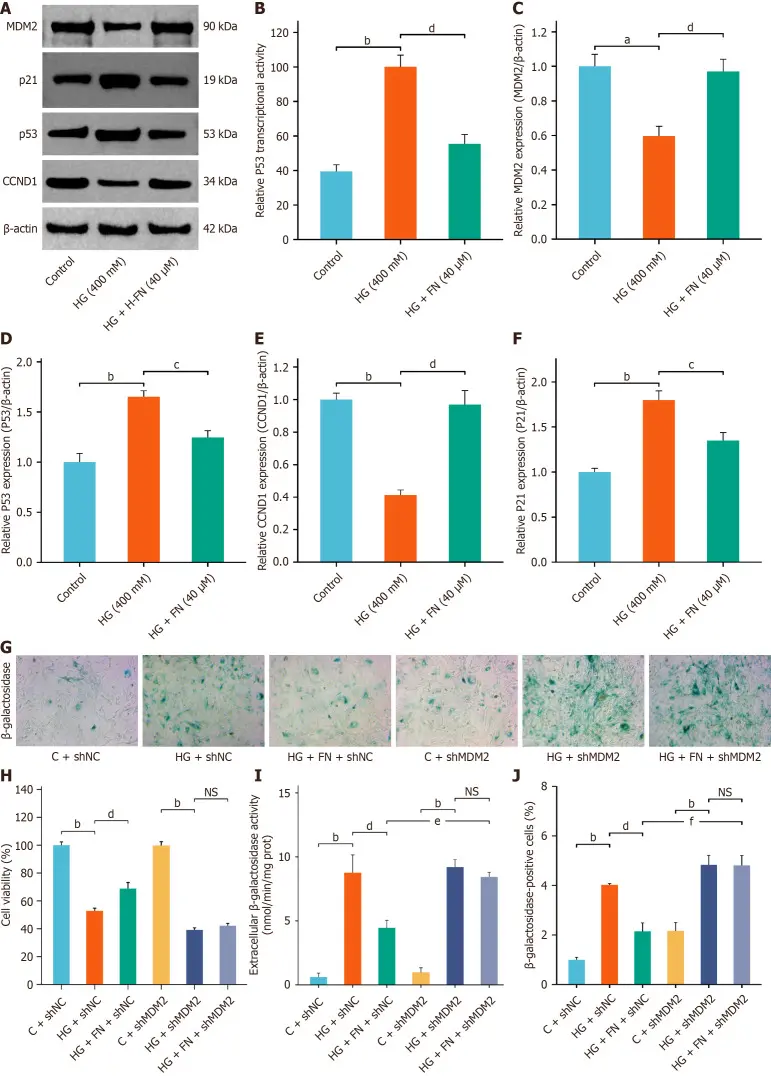
This study aimed to evaluate the efficacy of formononetin (FN) using an in vitro model of high glucose (HG)-induced injury in MPC-5 podocytes. Transcriptomic profiling was employed to assess the influence of FN on global gene expression and to identify key signaling pathways affected by FN treatment.
In the HG-induced MPC-5 cell model, FN treatment significantly enhanced cell viability and reduced the secretion of senescence-associated secretory phenotype (SASP) factors in the supernatant. Transcriptomic analysis revealed the p53 signaling pathway as a central target of FN under HG conditions. FN treatment markedly suppressed β-galactosidase (β-GAL) activity, upregulated the expression of MDM2 and CCND1, downregulated the expression of p53 and p21, and inhibited p53 transcriptional activity in MPC-5 cells. In diabetic kidney disease (DKD) mice, FN administration improved renal function, alleviated histopathological damage, reduced renal SASP levels and β-GAL activity, and normalized the expression of key proteins in the p53 pathway.
Ask a Question
Write your own review
Description: Immortalized Mouse Primary Artery Fibroblasts-GFP provided by Creative Bioarray have been developed by immortalizing mouse artery fibroblasts with SV40 Large T antigen and transfecting with tGFP. The ...
Description: Immortalized MHC II -/- Mouse Macrophage Cells (C2D) is derived from the knockout mice negative for MHCII molecule. They are stable in culture and survived through crisis in which they spontaneously ...
Description: The bone morphogenetic proteins (BMPs) produced by calvarial cells are crucial in osteoblastic differentiation and bone regeneration, however the limited lifespan of primary cells diminishes their ...
Description: The Immortalized Mouse Atrioventricular Cushion Mesenchymal Cells (tsA58-AVM) were derived from atrioventricular (AV) cushions of H-2Kb -tsA58 embryos at E9.5 and were conditionally immortalized in ...
Description: IDG-SW3 represent a non-homogenous population progressing from early osteoblasts to late osteocytic. These cells express functional SV40 large T antigen that is induced in the presence of IFN γ under ...
Description: The Immortalized Mouse Spleen Dendritic Cell (SRDC) line is functionally and phenotypically similar to dendritic cells; specifically, in its antigen presentation, T cell priming, and dendritic cell ...
- Adipose Tissue-Derived Stem Cells
- Human Neurons
- Mouse Probe
- Whole Chromosome Painting Probes
- Hepatic Cells
- Renal Cells
- In Vitro ADME Kits
- Tissue Microarray
- Tissue Blocks
- Tissue Sections
- FFPE Cell Pellet
- Probe
- Centromere Probes
- Telomere Probes
- Satellite Enumeration Probes
- Subtelomere Specific Probes
- Bacterial Probes
- ISH/FISH Probes
- Exosome Isolation Kit
- Human Adult Stem Cells
- Mouse Stem Cells
- iPSCs
- Mouse Embryonic Stem Cells
- iPSC Differentiation Kits
- Mesenchymal Stem Cells
- Immortalized Human Cells
- Immortalized Murine Cells
- Cell Immortalization Kit
- Adipose Cells
- Cardiac Cells
- Dermal Cells
- Epidermal Cells
- Peripheral Blood Mononuclear Cells
- Umbilical Cord Cells
- Monkey Primary Cells
- Mouse Primary Cells
- Breast Tumor Cells
- Colorectal Tumor Cells
- Esophageal Tumor Cells
- Lung Tumor Cells
- Leukemia/Lymphoma/Myeloma Cells
- Ovarian Tumor Cells
- Pancreatic Tumor Cells
- Mouse Tumor Cells