

Immortalized Mouse Mesangial Cells-SV40
Cat.No.: CSC-I9238L
Species: Mus musculus
Source: Kidney/glomerulus
Culture Properties: Adherent
- Specification
- Background
- Scientific Data
- Q & A
- Customer Review
Note: Never can cells be kept at -20 °C.
CIK-HT003 HT® Lenti-SV40T Immortalization Kit
Immortalized Mouse Mesangial Cells-SV40 refer to a cell line that was immortalized with SV40 large T antigen derived from mouse glomerular mesangial cells. These cells are frequently used as they provide a consistent cell source. Mesangial cells are mesenchymal cells found in the glomerulus. Their functions include structural support of the glomerulus, regulation of glomerular capillary blood flow, and turnover of ECM. Primary mesangial cells have limited lifespan and may have differences between batches; however, Immortalized Mouse Mesangial Cells-SV40 allow for constant proliferation of mesangial cells while maintaining important characteristics of primary mesangial cells such as reactivity to vasoactive compounds like angiotensin II and cytokines like TGF-β. Markers that are expressed by mesangial cells include α-smooth muscle actin (α-SMA), desmin, and extracellular matrix proteins like collagen IV and fibronectin. These cells are commonly used to study glomerular diseases including diabetic nephropathy and glomerulosclerosis as well as renal fibrosis and inflammation. They can be used to study cell proliferation, cell death/apoptosis, ECM production, oxidative stress and many other cellular functions. Studies have looked at the TGF-β/Smad signaling pathway as well as MAPK and NF-κB pathways in these cells.
Expression Levels Profile of Candidate Genes of Reference
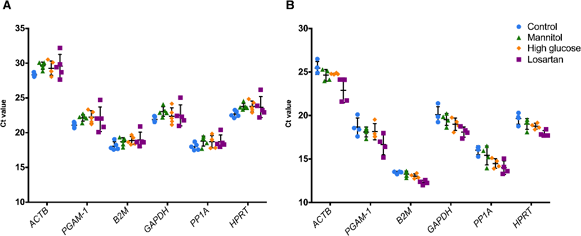
Accurate qPCR normalization requires stable reference genes, yet no consensus exists for mesangial cells and podocytes under diabetic kidney disease (DKD) conditions. Hosni et al. identified the optimal reference gene combinations for these cell lines in high-glucose and losartan-treated in vitro DKD models.
Raw Ct values were acquired in triplicate for both immortalized mouse mesangial cell and podocyte samples and analyzed according to each stimulus received. Ct values are inversely proportional to gene expression. The Ct mean of the candidate genes ranged from 29.20 to 18.55 in mesangial cells. The highest Ct among the candidate genes in mesangial cells was achieved by ACTB (29.20 ± 1.09), and the lowest was achieved by PPIA (18.55 ± 0.79). HPRT showed a mean of 23.48 ± 0.97, followed by GAPDH (22.46 ± 1.04), PGAM-1 21.86 ± 1.06 and B2M 18.66 ± 0.78. For podocytes, otherwise, the mean ranged from 24.45 to 13.02. ACTB achieved the highest value (24.45 ± 1.2), while the lowest value was achieved by B2M (13.02 ± 0.51). The remaining candidates showed a mean between 19.19 and 14.98: GAPDH (19.19 ± 1.00) was followed by HPRT (18.85 ± 0.79), PGAM-1 (17.90 ± 1.16) and PPIA (14.98 ± 1.06). The mean Ct value of the triplicates according to each gene and cell line is shown in Fig 1A and B.
Ask a Question
Write your own review
Description: Immortalized Mouse Primary Artery Fibroblasts-GFP provided by Creative Bioarray have been developed by immortalizing mouse artery fibroblasts with SV40 Large T antigen and transfecting with tGFP. The ...
Description: Immortalized MHC II -/- Mouse Macrophage Cells (C2D) is derived from the knockout mice negative for MHCII molecule. They are stable in culture and survived through crisis in which they spontaneously ...
Description: The bone morphogenetic proteins (BMPs) produced by calvarial cells are crucial in osteoblastic differentiation and bone regeneration, however the limited lifespan of primary cells diminishes their ...
Description: The Immortalized Mouse Atrioventricular Cushion Mesenchymal Cells (tsA58-AVM) were derived from atrioventricular (AV) cushions of H-2Kb -tsA58 embryos at E9.5 and were conditionally immortalized in ...
Description: IDG-SW3 represent a non-homogenous population progressing from early osteoblasts to late osteocytic. These cells express functional SV40 large T antigen that is induced in the presence of IFN γ under ...
Description: The Immortalized Mouse Spleen Dendritic Cell (SRDC) line is functionally and phenotypically similar to dendritic cells; specifically, in its antigen presentation, T cell priming, and dendritic cell ...
- Adipose Tissue-Derived Stem Cells
- Human Neurons
- Mouse Probe
- Whole Chromosome Painting Probes
- Hepatic Cells
- Renal Cells
- In Vitro ADME Kits
- Tissue Microarray
- Tissue Blocks
- Tissue Sections
- FFPE Cell Pellet
- Probe
- Centromere Probes
- Telomere Probes
- Satellite Enumeration Probes
- Subtelomere Specific Probes
- Bacterial Probes
- ISH/FISH Probes
- Exosome Isolation Kit
- Human Adult Stem Cells
- Mouse Stem Cells
- iPSCs
- Mouse Embryonic Stem Cells
- iPSC Differentiation Kits
- Mesenchymal Stem Cells
- Immortalized Human Cells
- Immortalized Murine Cells
- Cell Immortalization Kit
- Adipose Cells
- Cardiac Cells
- Dermal Cells
- Epidermal Cells
- Peripheral Blood Mononuclear Cells
- Umbilical Cord Cells
- Monkey Primary Cells
- Mouse Primary Cells
- Breast Tumor Cells
- Colorectal Tumor Cells
- Esophageal Tumor Cells
- Lung Tumor Cells
- Leukemia/Lymphoma/Myeloma Cells
- Ovarian Tumor Cells
- Pancreatic Tumor Cells
- Mouse Tumor Cells