
Immortalized Human Osteoblasts-SV40T+hTERT
Cat.No.: CSC-I2099Z
Morphology: Polygonal
Culture Properties: Adherent
- Specification
- Background
- Scientific Data
- Q & A
- Customer Review
Note: Never can cells be kept at -20°C.
Immortalized Human Osteoblasts-SV40T + hTERT are an osteogenic cell line that were created from primary human osteoblasts that were extracted from either cortical or trabecular bone. These cells are stably immortalized by SV40 large T antigen dual immortalization and hTERT overexpression. Morphologically, these cells retain epithelial-like adhesion in a polygonal shape, and express alkaline phosphatase (ALP), type I collagen, Runx2, osteocalcin, and osteopontin, all of which are markers expressed by osteoblasts. They are also able to retain high mineralization capacity, elevated ALP activity, and the deposition of calcium under osteogenic induction media, all of which are characteristic of osteoblasts in vivo.
Functionally, SV40T + hTERT osteoblasts are highly sensitive to bone-metabolic hormonal, inflammatory, and mechanical signals, while still retaining their ECM-producing, mineral-depositing, and RANKL/OPG signaling capabilities, and thus can be used as a model system for in vitro studies of bone remodeling. For this reason, the SV40T + hTERT osteoblast cell line can be used in many different studies, including, but not limited to the research of osteoporosis, the biocompatibility of biomaterials, osteogenic differentiation, bone regeneration, and anabolic/anti-resorptive drug screening.
Expression of ACSL4 in OS Tissues and Cells
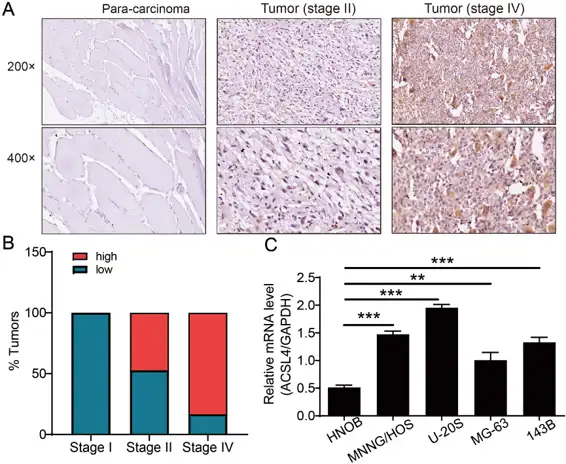
Osteosarcoma (OS) is a malignant bone sarcoma. ACSL4, an oncogene in many tumors, is poorly understood in OS. Li's team investigated ACSL4 expression in OS tissues and cells and explores its biological effects on OS progression. To investigate the role of ACSL4 in osteosarcoma (OS), they compared its expression in OS tumor tissues and adjacent normal tissues using IHC. As shown in Fig. 1, ACSL4 expression was significantly higher in OS tumor tissues than in adjacent normal tissues. They further analyzed the correlation between ACSL4 expression and clinicopathological parameters in OS patients. ACSL4 expression varied among different tumor stages, and Spearman rank correlation analysis revealed a significant positive correlation between ACSL4 expression and tumor stage. In detail, the proportion of high ACSL4 expression in stage IV OS cases was 83.33%, while that in stage I cases was 47.17% (Fig. 1B). In addition, they detected the ACSL4 mRNA levels in OS cell lines (MNNG/HOS, U-2OS, MG-63 and 143B) and SV40T-immortalized human osteoblasts (HNOB). The results showed that OS cell lines had higher ACSL4 mRNA levels than HNOB (Fig. 1C). These data indicate a potential link between ACSL4 and OS progression.
Ask a Question
Write your own review

Description: Nasal epithelial cells form the outermost protective layer against environmental factors. They clean, humidify, and warm inhaled air. They produces mucus, which binds particles that are subsequently ...
Description: Immortalized Human Corneal Epithelial Cells-SV40 have been obtained immortalizing Human Corneal Epithelial Cells with Lenti-SV40 Lentivirus. Immortalized cells were controlled passaging side by side ...
Description: Immortalized Human Lymphatic Endothelial Cells-SV40 were developed from human tissues transduced with a lentiviral expression vector containing the SV40T gene. The cell line was continuously cultured ...
Description: Immortalized Human Retinal Pigment Epithelial Cells were isolated from neonatal human globes and spontaneously immortalized in culture bypassing crisis. They retained typical morphology of the ...
- Adipose Tissue-Derived Stem Cells
- Human Neurons
- Mouse Probe
- Whole Chromosome Painting Probes
- Hepatic Cells
- Renal Cells
- In Vitro ADME Kits
- Tissue Microarray
- Tissue Blocks
- Tissue Sections
- FFPE Cell Pellet
- Probe
- Centromere Probes
- Telomere Probes
- Satellite Enumeration Probes
- Subtelomere Specific Probes
- Bacterial Probes
- ISH/FISH Probes
- Exosome Isolation Kit
- Human Adult Stem Cells
- Mouse Stem Cells
- iPSCs
- Mouse Embryonic Stem Cells
- iPSC Differentiation Kits
- Mesenchymal Stem Cells
- Immortalized Human Cells
- Immortalized Murine Cells
- Cell Immortalization Kit
- Adipose Cells
- Cardiac Cells
- Dermal Cells
- Epidermal Cells
- Peripheral Blood Mononuclear Cells
- Umbilical Cord Cells
- Monkey Primary Cells
- Mouse Primary Cells
- Breast Tumor Cells
- Colorectal Tumor Cells
- Esophageal Tumor Cells
- Lung Tumor Cells
- Leukemia/Lymphoma/Myeloma Cells
- Ovarian Tumor Cells
- Pancreatic Tumor Cells
- Mouse Tumor Cells