

ASPC-1/GEM
Cat.No.: CSC-C8215L-GEM
Species: Homo sapiens (Human)
Source: Ascites Metastasis
Morphology: Epithelial
Culture Properties: Adherent
- Specification
- Background
- Scientific Data
- Q & A
- Customer Review
ASPC-1/GEM is a gemcitabine-resistant derivative of the human pancreatic adenocarcinoma cell line AsPC-1, generated through repeated drug exposure. ASPC-1/GEM exhibits epithelial morphology and adherent growth, providing an expandable model for investigating acquired chemoresistance in a human pancreatic cancer background.
Its principal advantage is the ability to compare a drug-selected population with its corresponding parental cells. This paired approach supports identification of resistance-associated molecular changes and evaluation of interventions intended to restore gemcitabine sensitivity. Dose–response measurements can be combined with proliferation, colony formation, and apoptosis assays to distinguish changes in drug responsiveness from general growth inhibition. Using parental and resistant cultures under matched conditions strengthens interpretation of these comparisons.
An additional strength is compatibility with complementary in vitro and xenograft experiments, enabling candidate sensitization strategies to be evaluated beyond cell viability alone. However, independently generated AsPC-1-resistant derivatives can differ in selection history, resistance magnitude, and underlying mechanisms. Findings from one preparation should therefore be validated in the specific stock used.
A Novel Approach to Overcoming Gemcitabine Resistance in Pancreatic Ductal Adenocarcinoma
In the study, Zhao, Qixin developed a mitochondria-targeted hydrogel formulation, SWMU690@PUE. The hydrogel construct was precisely designed via the spontaneous supramolecular assembly of puerarin (PUE) and SWMU690 components, facilitated under carefully controlled thermodynamic conditions. The compound SWMU690 has been delineated as a potent antagonist capable of abrogating the pro-oncogenic phenotype of mitochondria in neoplastic cells during the initial stages of tumorigenesis. To elucidate the mechanistic underpinnings of SWMU690@PUE, they conducted an in vitro investigation to ascertain its capacity to ameliorate drug resistance in tumor cells by modulating mitochondrial functionality.
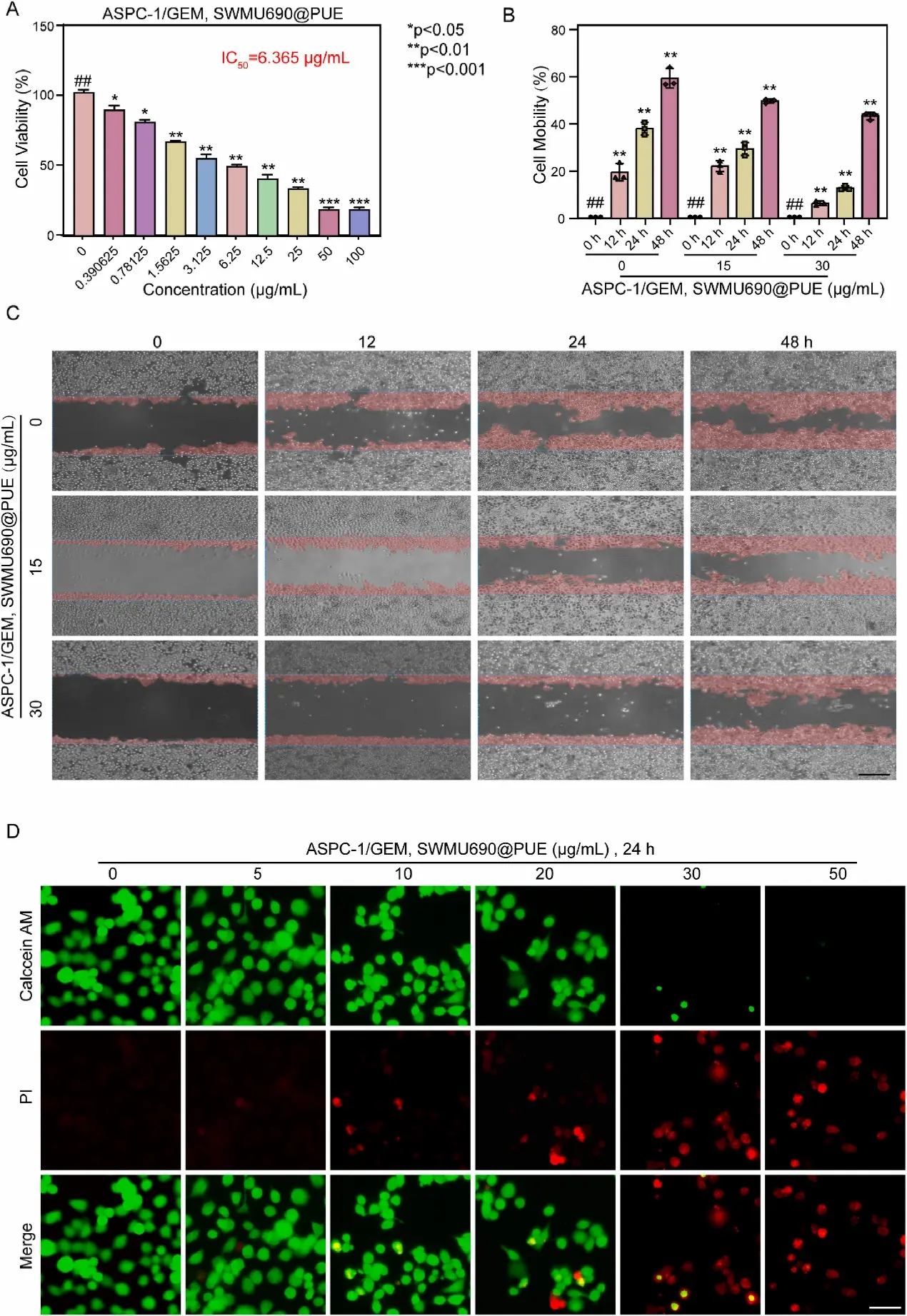
The antitumor activity of SWMU690@PUE was quantitatively assessed using CCK-8 assays (Fig. 1A), demonstrating significant concentration-dependent inhibition of ASPC-1/GEM cell proliferation. Concurrently, they observed that at elevated concentrations (30 μg/mL and 15 μg/mL) and lower concentration range (10 μg/mL and 5 μg/mL), SWMU690@PUE significantly impeded the migratory capacity of ASPC-1/GEM cells, demonstrating a dose-dependent and time-dependent inhibitory effect on cell migration (Fig. 1B and C). Furthermore, fluorescence-based viability assays corroborated these findings, as post-treatment with SWMU690@PUE resulted in a substantial increase in the number of necrotic ASPC-1/GEM cells, thereby substantiating the compound's antitumor activity (Fig. 1D).
Ask a Question
Write your own review
Description: The drug resistant cell line K562 AZQ has been developed from the parent K562 cell line by treatment with AZQ C215-bis (carboethoxyamino)-3, 6-diazitinyl 1;4 (benzoquinone). The cells have been shown ...
Description: The Paclitaxel-resistant cell line HCT-15/taxol has been developed by repeatedly exposing the parent HCT-15 cell line to Paclitaxel. To retain its resistance, Paclitaxel must be continuously added to ...
Description: The adriamycin-resistant cell line A2780ADR has been developed by exposure of the parent A2780 cell line to adriamycin. A2780ADR is cross-resistant to melphalan and vinblastine. To retain resistance ...
Description: The Paclitaxel-resistant cell line WSU-HN30/Taxol has been developed by repeatedly exposing the parent WSU-HN30 cell line to Paclitaxel. To retain its resistance, Paclitaxel must be continuously ...
Description: The Oxaliplatin-resistant cell line MKN-45/L-OHP has been developed by repeatedly exposing the parent MKN-45 cell line to Oxaliplatin. To retain its resistance, Oxaliplatin must be continuously added ...
Description: The Fluorouracil-resistant cell line HCT-15/5FU has been developed by repeatedly exposing the parent HCT-15 cell line to Fluorouracil. To retain its resistance, Fluorouracil must be continuously ...
- Adipose Tissue-Derived Stem Cells
- Human Neurons
- Mouse Probe
- Whole Chromosome Painting Probes
- Hepatic Cells
- Renal Cells
- In Vitro ADME Kits
- Tissue Microarray
- Tissue Blocks
- Tissue Sections
- FFPE Cell Pellet
- Probe
- Centromere Probes
- Telomere Probes
- Satellite Enumeration Probes
- Subtelomere Specific Probes
- Bacterial Probes
- ISH/FISH Probes
- Exosome Isolation Kit
- Human Adult Stem Cells
- Mouse Stem Cells
- iPSCs
- Mouse Embryonic Stem Cells
- iPSC Differentiation Kits
- Mesenchymal Stem Cells
- Immortalized Human Cells
- Immortalized Murine Cells
- Cell Immortalization Kit
- Adipose Cells
- Cardiac Cells
- Dermal Cells
- Epidermal Cells
- Peripheral Blood Mononuclear Cells
- Umbilical Cord Cells
- Monkey Primary Cells
- Mouse Primary Cells
- Breast Tumor Cells
- Colorectal Tumor Cells
- Esophageal Tumor Cells
- Lung Tumor Cells
- Leukemia/Lymphoma/Myeloma Cells
- Ovarian Tumor Cells
- Pancreatic Tumor Cells
- Mouse Tumor Cells