
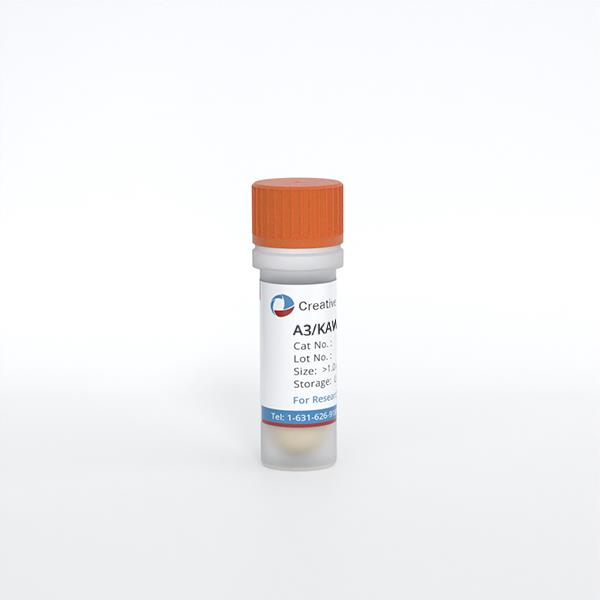
A3/KAW
Cat.No.: CSC-C6975J
Species: Homo sapiens (Human)
Source: Ascites
Morphology: Lymphocyte-Like
- Specification
- Background
- Scientific Data
- Q & A
- Customer Review
Hirose et al. derived the A3/KAW cell line (also referred to as A3/Kawakami) in 1983 from the ascitic fluid of a 68-year-old Japanese woman with gastric malignant lymphoma (diffuse large cell-type non-Hodgkin lymphoma). A3/KAW cells have distinctive immunophenotype of CD4-positive, Ia-negative and EBNA-negative lymphoma cells, on which OKT4 and anti-Leu 3a react. Interestingly, while the original ascitic lymphoma cells displayed surface immunoglobulin positivity, the cultured A3/KAW cells lost expression of definitive B-cell markers. Recent studies suggest that A3/KAW may not express typical B-cell genes such as CD19, CD20, or CD79, raising caution regarding its classification as a diffuse large B-cell lymphoma (DLBCL) model.
A3/KAW cells grow as suspension cells and have a doubling time of 20 hours in RPMI 1640 medium containing 10% fetal bovine serum. A3/KAW cells have a karyotype of 48XY+14q, marker and have 840 known mutations. The cells have many copy number mutations.
IKE Potently Reduces diffuse large B cell lymphoma (DLBCL) Cell Number
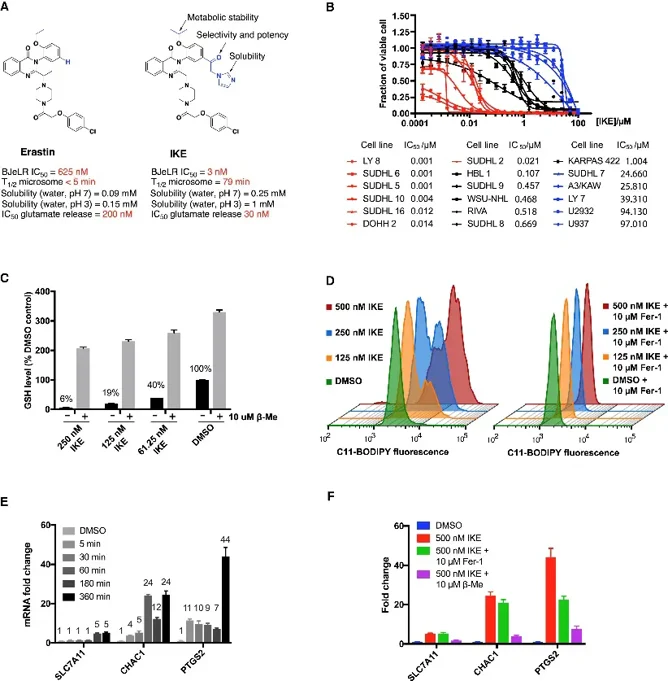
The ferroptosis inducer erastin is metabolically labile with low water solubility and potency, limiting in vivo use. IKE, an erastin analog with a carbonyl group (Fig. 1A), forms reversible covalent protein interactions, achieving >100× potency improvement in some cell lines. Isopropoxy substitution enhanced metabolic stability, while the imidazole moiety increased water solubility and ketone stability under acidic conditions.
Zhang's team evaluated DLBCL cell line sensitivity to ferroptosis and established a lymphoma xenograft model. A panel of 18 DLBCL cell lines (LY8, DOHH2, SUDHL5, SUDHL2, SUDHL6, SUDHL10, and SUDHL16 were classified as sensitive cell lines (red). HBL1, SUDHL9, WSU-NHL, SUDHL8, RIVA, and KARPAS422 were classified as moderately resistant cell lines (black). SUDHL7, U937, A3/KAW, LY7, and U2932 were classified as resistant cell lines (blue)) across distinct subtypes showed differential IKE sensitivity: IC₅₀ < 100 nM (sensitive), IC₅₀ > 10 μM (resistant), and intermediate values between 100 nM and 10 μM (Fig. 1B). Co-treatment with ferrostatin-1 (fer-1), a ferroptosis inhibitor, rescued IKE-induced cell death, confirming lipid peroxidation-mediated ferroptosis. Among sensitive lines, SUDHL6 was selected for subcutaneous xenograft generation in 6-week-old male NCG mice.
Ask a Question
Write your own review
- You May Also Need
Description: Established in 2007 from the bone marrow mononuclear cells of an 82-year-old Japanese man with diffuse large B-cell lymphoma in the leukemic phase
Description: Established from the bone marrow of a 28-year-old man who developed the terminal leukemic phase of lymphosarcoma in 1976
Description: This cell line was derived from the bone marrow aspirate of a 59 year old male with erythroleukemia that became acute myelogenous leukaemia.The cells form colonies in soft-agar in the presence of ...
Description: Established from the pleural effusion of a 24-year-old woman with recurrent anaplastic large cell lymphoma (ALCL); cells were described to clonally derive from T-lineage lymphoid cells and to be ...
Description: Established from a 37-year-old man at second (refractory/terminal) relapse of Hodgkin lymphoma (nodular sclerosing -> lymphocyte depleted/stage IIISA -> stage IV) after both combined chemo- and ...
Description: Established from the peripheral blood of a 10-year-old Caucasian boy with acute lymphoblastic leukemia (pre B-ALL) at diagnosis in 1993
- Adipose Tissue-Derived Stem Cells
- Human Neurons
- Mouse Probe
- Whole Chromosome Painting Probes
- Hepatic Cells
- Renal Cells
- In Vitro ADME Kits
- Tissue Microarray
- Tissue Blocks
- Tissue Sections
- FFPE Cell Pellet
- Probe
- Centromere Probes
- Telomere Probes
- Satellite Enumeration Probes
- Subtelomere Specific Probes
- Bacterial Probes
- ISH/FISH Probes
- Exosome Isolation Kit
- Human Adult Stem Cells
- Mouse Stem Cells
- iPSCs
- Mouse Embryonic Stem Cells
- iPSC Differentiation Kits
- Mesenchymal Stem Cells
- Immortalized Human Cells
- Immortalized Murine Cells
- Cell Immortalization Kit
- Adipose Cells
- Cardiac Cells
- Dermal Cells
- Epidermal Cells
- Peripheral Blood Mononuclear Cells
- Umbilical Cord Cells
- Monkey Primary Cells
- Mouse Primary Cells
- Breast Tumor Cells
- Colorectal Tumor Cells
- Esophageal Tumor Cells
- Lung Tumor Cells
- Leukemia/Lymphoma/Myeloma Cells
- Ovarian Tumor Cells
- Pancreatic Tumor Cells
- Mouse Tumor Cells