
SW48
Cat.No.: CSC-6316W
Species: Homo sapiens (Human)
Source: Intestine; Colon
Morphology: continuous culture, grown as monolayer, morphology epithelial-like
Culture Properties: monolayer
- Specification
- Background
- Scientific Data
- Q & A
- Customer Review
Tissue: colon;
Tumor: adenocarcinoma, grade IV
Derived from an untreated grade IV colon adenocarcinoma, SW48 is a near-diploid, DNA mismatch repair (MMR)-deficient human colorectal cancer line distinguished not by generic tumorigenicity, but by three interrelated, experimentally exploitable paradoxes.
- MMR-Deficient yet Alkylation-Tolerant: SW48 lacks MLH1 expression (MSI-H) and is MGMT-null. Paradoxically, it exhibits marked resistance to methylating agents-a tolerance phenotype directly conferred by its MMR defect. This rare combination provides a dedicated platform for dissecting DNA damage tolerance, repair silencing, and chemoresistance in MSI-H cancers.
- TGFBR2-Mutated yet Signaling-Competent: Despite biallelic frameshifts in the TGFBR2 polyadenine tract, SW48 retains ligand-dependent SMAD2 phosphorylation and transcriptional responsiveness. This challenges mutation-function dogma and establishes it as a critical tool for re-evaluating TGFβ tumor suppression in microsatellite-unstable contexts.
- 3D Competence Re-Established: Long recognized for necrotic-center spheroid formation, SW48 has recently been re-optimized for reproducible, scaffold-free 3D culture-overturning prior assumptions of non-spherogenicity and enabling cost-effective, high-throughput drug testing in physiologically relevant tumor architectures.
Authenticated, fully sequenced, and functionally paradoxical, SW48 is not a generic MSI line-it is a precision tool for probing MMR biology, mutation-function discordance, and 3D tumor pharmacology.
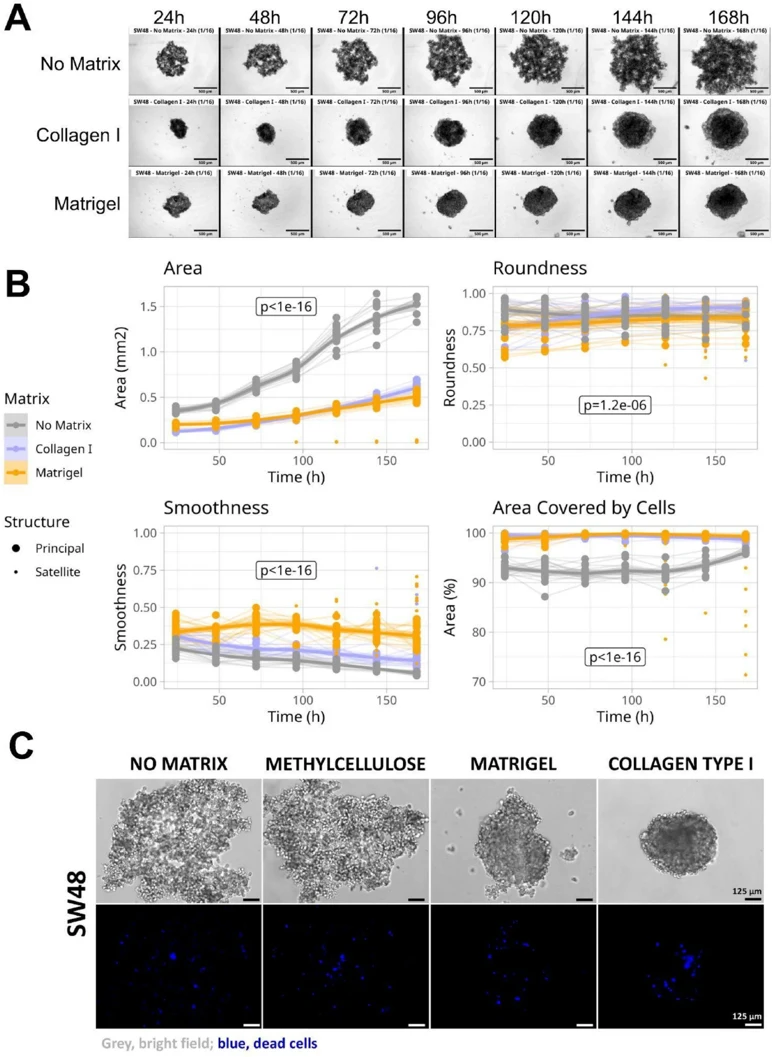
Development of A Novel SW48 3D Model
Three-dimensional (3D) cell culture models have emerged as more physiologically relevant alternatives to traditional two-dimensional (2D) models for drug screening and mechanistic studies. This study successfully developed a novel compact spheroid model using the SW48 cell line.
We evaluated the effect of treating the 96-well plates with an anti-adherence solution while culturing SW48 in absence or presence of methylcellulose. In parallel, we cultured two other cell lines, HCT116 and LS174T, as controls. This experiment revealed that the treatment with the anti-adherence solution facilitated the formation of multicellular tumor spheroids (MCTSs) in all three cell lines even in the absence of methylcellulose. We then investigated if the addition of Matrigel or collagen I to the solution treated 96-well plates would lead to the formation of more compact SW48 MCTSs. These conditions allowed the generation of SW48 spheroids, exhibiting a more compact and spherical morphology in the presence of Matrigel and collagen type I compared to cultures in the absence of a matrix or cultured with methylcellulose. We monitored SW48 3D morphology in 7 days culture in anti-adherence-treated 96-well plates revealed that SW48 cells formed smaller and more compact spheroids in Matrigel or collagen I, compared to cultures without hydrogels. While similar in size and compactness, Matrigel-cultured spheroids were notably less round and featured a smoother surface than those in collagen I.
Ask a Question
Write your own review
- You May Also Need
Description: The C10 cell line was established from a 71-year old male patient with moderately well differentiated adenocarcinoma of the descending colon classified as Dukes' stage B.
Description: Established from an adenocarcinoma located in the ascending colon of a 68 year-old male patient. The adenocarcinoma was well differentiated and determined to be Dukes' stage B. Imperial College ...
Description: The SW 626 cell line was initiated by A. Leibovitz in January 1974 at the Scott and White Clinic, Temple, Texas from a surgical specimen from a cystadenocarcinoma of the ovary in a 46 year old female ...
Description: This is one cell line out of a series of colon carcinoma cell lines established by PD Dr. Michael Linnebacher.
Description: Rectal carcinoma from a Japanese patient. Cell growth is slow.
Description: The C80 cell line was established from a 69-year old male patient with a moderately well differentiated adenocarcinoma of the rectum classified as Dukes' stage D.
- Adipose Tissue-Derived Stem Cells
- Human Neurons
- Mouse Probe
- Whole Chromosome Painting Probes
- Hepatic Cells
- Renal Cells
- In Vitro ADME Kits
- Tissue Microarray
- Tissue Blocks
- Tissue Sections
- FFPE Cell Pellet
- Probe
- Centromere Probes
- Telomere Probes
- Satellite Enumeration Probes
- Subtelomere Specific Probes
- Bacterial Probes
- ISH/FISH Probes
- Exosome Isolation Kit
- Human Adult Stem Cells
- Mouse Stem Cells
- iPSCs
- Mouse Embryonic Stem Cells
- iPSC Differentiation Kits
- Mesenchymal Stem Cells
- Immortalized Human Cells
- Immortalized Murine Cells
- Cell Immortalization Kit
- Adipose Cells
- Cardiac Cells
- Dermal Cells
- Epidermal Cells
- Peripheral Blood Mononuclear Cells
- Umbilical Cord Cells
- Monkey Primary Cells
- Mouse Primary Cells
- Breast Tumor Cells
- Colorectal Tumor Cells
- Esophageal Tumor Cells
- Lung Tumor Cells
- Leukemia/Lymphoma/Myeloma Cells
- Ovarian Tumor Cells
- Pancreatic Tumor Cells
- Mouse Tumor Cells