
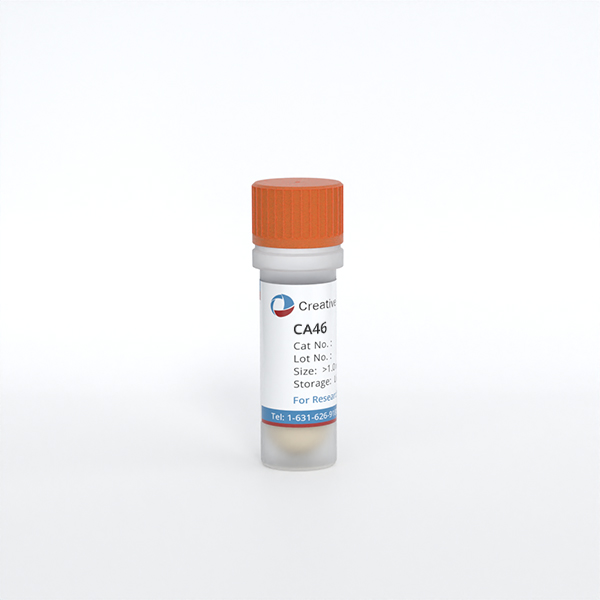
CA46
Cat.No.: CSC-C9093W
Species: Homo sapiens (Human)
Source: Ascites
Morphology: single cells in suspension
- Specification
- Background
- Scientific Data
- Q & A
- Customer Review
The CA46 cell line is a human Epstein-Barr virus (EBV)-negative Burkitt lymphoma line established from the ascitic fluid of a patient with advanced disease. As an EBV-negative, MYC-driven model, CA46 offers a uniquely clean genetic background for dissecting the intrinsic mechanisms of B-cell lymphomagenesis without confounding viral latency programs.
The hallmark of CA46 cells is the canonical t(8;14)(q24;q32) translocation, which juxtaposes the c-MYC oncogene to the immunoglobulin heavy-chain enhancer, driving constitutive MYC overexpression. This single oncogenic hit faithfully represents the pathogenesis of sporadic Burkitt lymphoma. Phenotypically, the cells display a germinal center B-cell profile (CD10⁺, CD19⁺, CD20⁺, CD38⁺) and express surface IgM with lambda light-chain restriction, confirming clonal B-cell origin. They proliferate rapidly in suspension as single-cell lymphoblasts, enabling facile large-scale expansion, reproducible in vitro assays, and amenability to genetic manipulation, including electroporation and lentiviral transduction.
Importantly, the absence of EBV latent proteins (EBNA1, LMP1) eliminates viral interference with key signaling pathways such as NF-κB and BCL-2, making CA46 an ideal platform for studying MYC transcriptional networks, B-cell receptor signaling, and apoptosis regulation. The cells carry a wild-type TP53 gene (though MDM2 may be overexpressed), providing a defined apoptotic axis for drug sensitivity studies. When inoculated subcutaneously or systemically into immunodeficient mice, CA46 forms aggressive tumors that mimic clinical Burkitt lymphoma histology and lactate dehydrogenase elevation, supporting preclinical evaluation of targeted therapies.
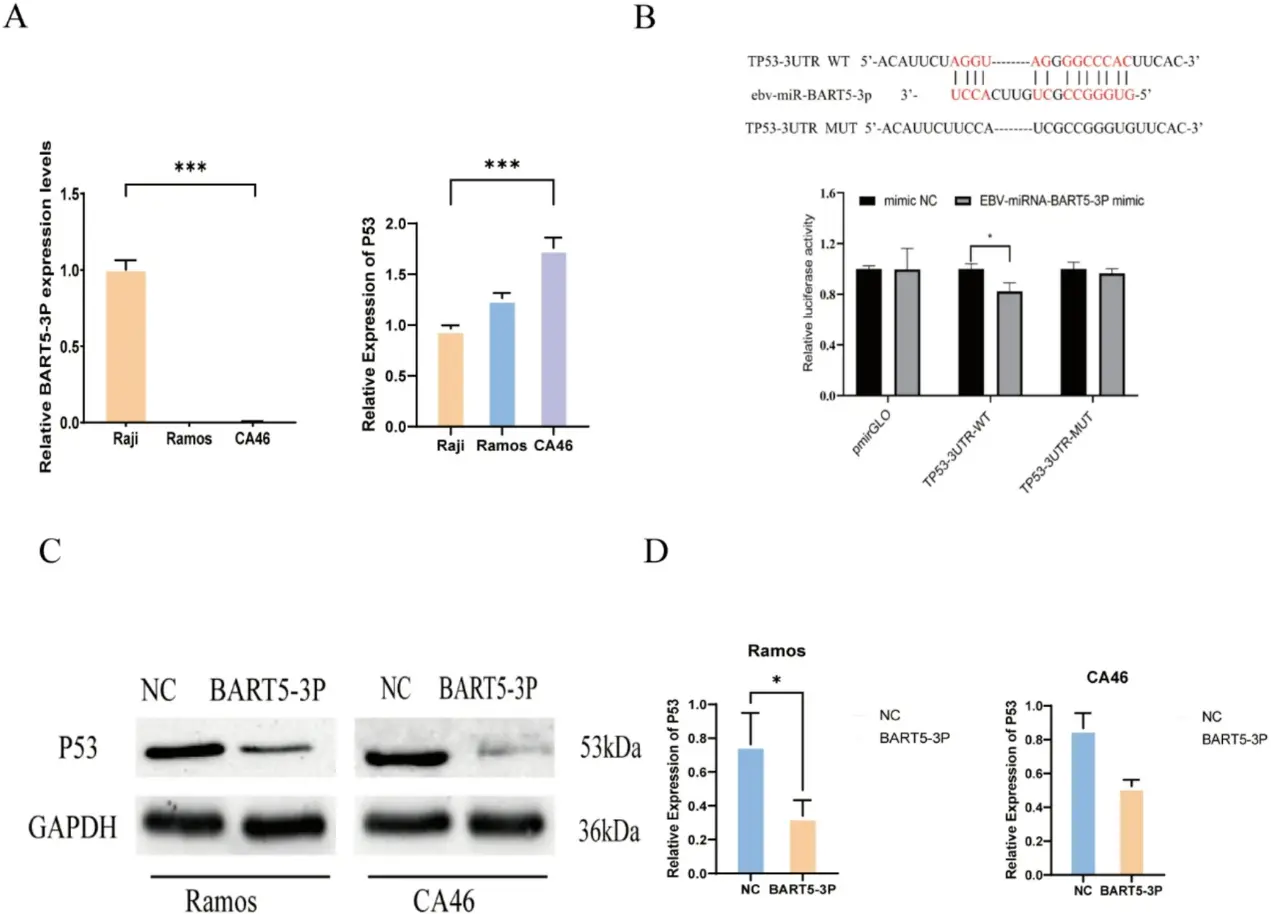
EBV-miR-BART5-3p Directly Targeted TP53 in Burkitt Lymphoma Cells
Epstein–Barr virus is a double‑stranded DNA virus that plays a key role throughout the development of Burkitt lymphoma. The EBV genome encodes 44 mature microRNAs (miR‑BARTs) that collectively promote tumorigenesis. TP53, a tumor suppressor protein, prevents cancer progress by inducing cell-cycle arrest, apoptosis, and modulating glycolysis. This study found that the downregulation of TP53 in Burkitt lymphoma cells may be affected by EBV-miR-BART5-3p (Fig. 1A). According to biological informatics analysis, the seed sequence of EBV-miR-BART5-3p and the 3’ -UTR of TP53 matched quite well. Additionally, EBV-miR-BART5-3p interacted with wild-type TP53 and markedly lowered the luciferase activity compared to the control mimics. However, there is no significant difference in luciferase activity when 3’ -UTR is mutant (Fig. 1B). EBV-miR-BART5-3p mimics specifically downregulated the expression of TP53 (Fig. 1C-D). Based on the aforementioned information, we demonstrated that EBV-miR-BART5-3p engaged in the reduction of TP53 levels in Burkitt lymphoma.
Ask a Question
Write your own review
- You May Also Need

Description: Established in 2007 from the bone marrow mononuclear cells of an 82-year-old Japanese man with diffuse large B-cell lymphoma in the leukemic phase
Description: Established at diagnosis from the pleural effusion of a 26-year-old Caucasian HIV + man with primary effusion lymphoma (PEL) in 1999; described to be HHV-8 +, EBV - and to display biallelic ...

Description: Established from the tumor mass of an African child with Burkitt lymphoma; this variant subline from the original NAMALWA was described to be characterized by differential expression of ...
Description: The MEG-01 cell line was derived in 1983 at the Nagoya University School of Medicine, Nagoya, Japan from bone marrow cells taken from a patient in megakaryoblastic crisis of CML

Description: Established from the bone marrow of a 28-year-old man who developed the terminal leukemic phase of lymphosarcoma in 1976

Description: Established from peripheral blood mononuclear cells of a 68-year-old white woman with mantle cell lymphoma at relapse in 1997; described to carry a t(11;14)(q13;q32) leading to CCND1-IGH@ (BCL1-IGH) ...
- Adipose Tissue-Derived Stem Cells
- Human Neurons
- Mouse Probe
- Whole Chromosome Painting Probes
- Hepatic Cells
- Renal Cells
- In Vitro ADME Kits
- Tissue Microarray
- Tissue Blocks
- Tissue Sections
- FFPE Cell Pellet
- Probe
- Centromere Probes
- Telomere Probes
- Satellite Enumeration Probes
- Subtelomere Specific Probes
- Bacterial Probes
- ISH/FISH Probes
- Exosome Isolation Kit
- Human Adult Stem Cells
- Mouse Stem Cells
- iPSCs
- Mouse Embryonic Stem Cells
- iPSC Differentiation Kits
- Mesenchymal Stem Cells
- Immortalized Human Cells
- Immortalized Murine Cells
- Cell Immortalization Kit
- Adipose Cells
- Cardiac Cells
- Dermal Cells
- Epidermal Cells
- Peripheral Blood Mononuclear Cells
- Umbilical Cord Cells
- Monkey Primary Cells
- Mouse Primary Cells
- Breast Tumor Cells
- Colorectal Tumor Cells
- Esophageal Tumor Cells
- Lung Tumor Cells
- Leukemia/Lymphoma/Myeloma Cells
- Ovarian Tumor Cells
- Pancreatic Tumor Cells
- Mouse Tumor Cells