
HT29-MTX-E12
Cat.No.: CSC-C7109J
Species: Homo sapiens (Human)
Source: Intestine; Colon
Morphology: Epithelial
Culture Properties: Adherent
- Specification
- Background
- Scientific Data
- Q & A
- Customer Review
HT29-MTX-E12 cell line is a well-differentiated, mucus-producing subclone derived from the parent human colorectal adenocarcinoma HT-29 line through long-term adaptation to the chemotherapeutic agent methotrexate (MTX). This selective pressure drives the cells toward a stable goblet cell-like phenotype, characterized by a markedly reduced proliferative rate and a constitutive commitment to differentiation. Unlike the heterogeneous parental line, HT29-MTX-E12 cells consistently express key hallmarks of intestinal goblet cells, most notably the robust production and apical secretion of gel-forming mucins, primarily MUC5AC, forming a functional, viscoelastic mucus layer. This specialized capability establishes it as the gold-standard in vitro model for studying the intestinal mucus barrier, a critical frontline defense system.
It is routinely combined with absorptive enterocyte models (e.g., Caco-2) in transwell co-culture systems to create more physiologically complete intestinal epithelium models. These co-cultures accurately segregate mucus production (HT29-MTX-E12) and tight junction formation (Caco-2), dramatically improving the predictive value for drug permeability, toxicology, and nutraceutical absorption studies.
Protocol For Developing a Mucus-producing Gut-on-a-chip Model from Caco-2 and HT29-MTX-E12 Cells
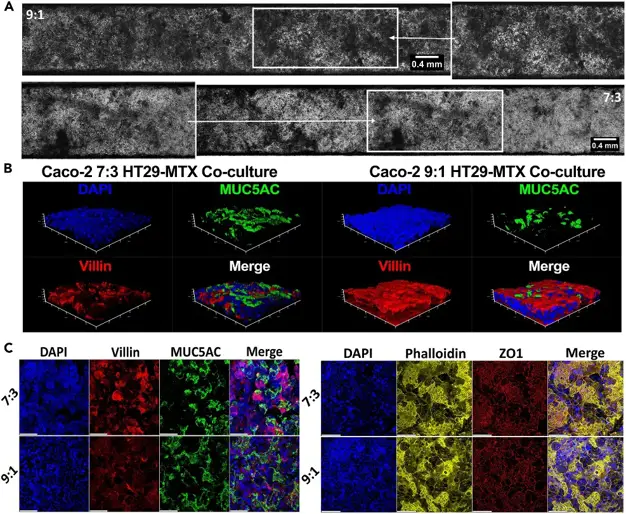
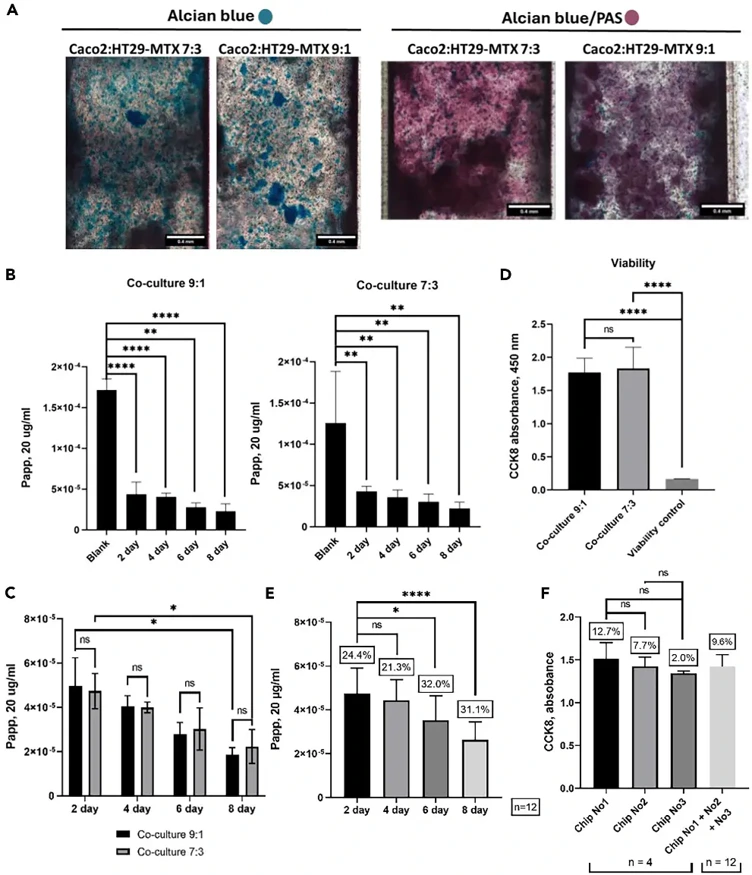
Organ-on-chip (OoC) technology offers a more relevant gut model in comparison with static in vitro gut models from stable cell lines by replicating the 3D structure, mucus production, fluid dynamics, and mechanical forces, closely simulating in vivo conditions. Here, we present a protocol for developing a mucus-producing gut-on-a-chip (GoC) model from Caco-2 and HT29-MTX-E12 cells. At the end of the experiment, immunofluorescence and confocal microscopy should confirm 3D structure formation, cell polarization, mucus production and tight junction formation in GoC model with relevant cell marker such as VIL1, Muc5AC and ZO1 expression, with Muc5AC expression expected to vary across different cell ratios.
Ask a Question
Write your own review
Description: Established from an adenocarcinoma located in the ascending colon of a 68 year-old male patient. The adenocarcinoma was well differentiated and determined to be Dukes' stage B. Imperial College ...
Description: This is one cell line out of a series of colon carcinoma cell lines established by PD Dr. Michael Linnebacher.
Description: Rectal carcinoma from a Japanese patient. Cell growth is slow.
Description: The C80 cell line was established from a 69-year old male patient with a moderately well differentiated adenocarcinoma of the rectum classified as Dukes' stage D.
Description: RKO is a poorly differentiated colon carcinoma cell line developed by Michael Brattain.
- Adipose Tissue-Derived Stem Cells
- Human Neurons
- Mouse Probe
- Whole Chromosome Painting Probes
- Hepatic Cells
- Renal Cells
- In Vitro ADME Kits
- Tissue Microarray
- Tissue Blocks
- Tissue Sections
- FFPE Cell Pellet
- Probe
- Centromere Probes
- Telomere Probes
- Satellite Enumeration Probes
- Subtelomere Specific Probes
- Bacterial Probes
- ISH/FISH Probes
- Exosome Isolation Kit
- Human Adult Stem Cells
- Mouse Stem Cells
- iPSCs
- Mouse Embryonic Stem Cells
- iPSC Differentiation Kits
- Mesenchymal Stem Cells
- Immortalized Human Cells
- Immortalized Murine Cells
- Cell Immortalization Kit
- Adipose Cells
- Cardiac Cells
- Dermal Cells
- Epidermal Cells
- Peripheral Blood Mononuclear Cells
- Umbilical Cord Cells
- Monkey Primary Cells
- Mouse Primary Cells
- Breast Tumor Cells
- Colorectal Tumor Cells
- Esophageal Tumor Cells
- Lung Tumor Cells
- Leukemia/Lymphoma/Myeloma Cells
- Ovarian Tumor Cells
- Pancreatic Tumor Cells
- Mouse Tumor Cells