
Ca9-22
Cat.No.: CSC-C6348J
Species: Homo sapiens (Human)
Source: Oral Cavity; Gingiva
Morphology: epithelial-like
Culture Properties: Adherent cells
- Specification
- Background
- Scientific Data
- Q & A
- Customer Review
Store in liquid nitrogen.
The Ca9-22 cell line is a human-derived epithelial model established from a gingival squamous cell carcinoma (OSCC) of the lower jaw. It serves as a specific and valuable tool for studying malignancies originating from the oral cavity, particularly those arising from the gingiva. Genomically, it carries mutations typical of OSCC, most notably a frequently cited TP53 mutation (R248L), which contributes to loss of tumor suppressor function and genomic instability. Phenotypically, it exhibits adherent, epithelial-like growth and forms moderately differentiated tumors in immunocompromised mice.
Current studies leveraging the Ca9-22 cell line focus on several key areas of oral oncology:
Molecular Pathogenesis of OSCC: Investigating the functional consequences of specific genetic alterations (e.g., mutant TP53 signaling) on cell cycle control, apoptosis, and the crosstalk with oncogenic pathways like PI3K/AKT.
Drug Repurposing and Novel Compound Screening: Serving as one of several OSCC cell lines in panels to screen for the efficacy of novel small molecules, natural compounds, or repurposed drugs targeting proliferation, survival, or sensitization to radiotherapy.
Angiogenesis and Tumor Microenvironment: Studying the expression and regulation of pro-angiogenic factors (e.g., VEGF) by OSCC cells and their paracrine effects on endothelial cells.
Biomarker Discovery and Validation: Used as a model system to validate the functional role of candidate genes or non-coding RNAs (e.g., miRNAs, lncRNAs) identified from clinical OSCC samples as promoters or suppressors of malignant phenotypes.
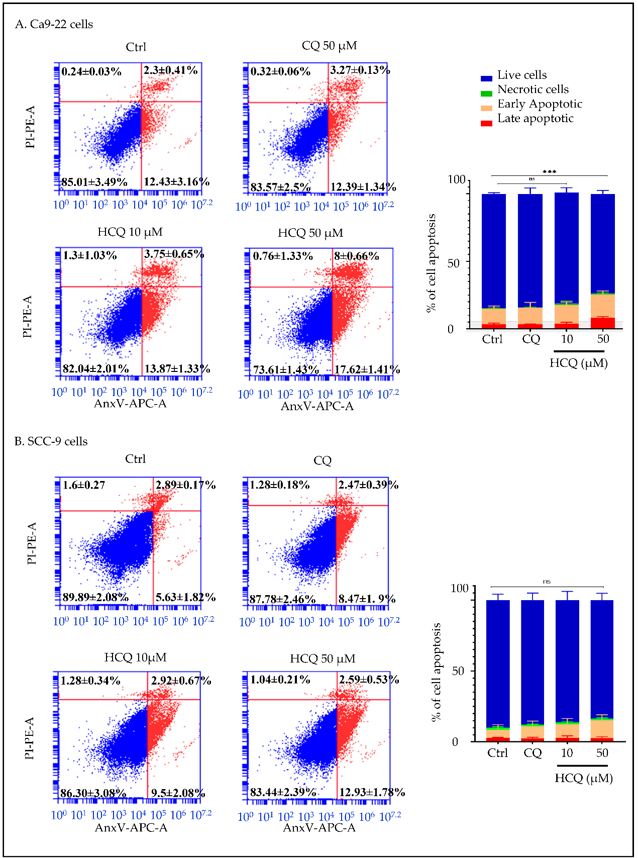
Selective Efficacy of Hydroxychloroquine on Gingival Squamous Cell Carcinoma
Oral cancer, the most common head and neck malignancy, has a high recurrence rate and poor prognosis largely owing to chemotherapy resistance. The adverse effects of conventional therapies have prompted investigations into safer and more effective alternative therapies. Chloroquine (CQ) and hydroxychloroquine (HCQ) have shown potential owing to their roles in autophagy modulation and immune regulation. This study clarifies the selective efficacy of CQ and HCQ in oral squamous cell carcinoma models, emphasizing distinct responses in gingival (Ca9-22) and tongue (SCC-9) carcinoma cells.
HCQ significantly reduced viability and colony formation in Ca9-22 cells while moderately affecting SCC-9 cells. Autophagy inhibition was accompanied by compensatory up-regulation of autophagy-related genes, consistent with feedback activation of TFEB and FOXO3a pathways. Gene expression profiling and flow-cytometry analyses revealed cell-type-specific differences in apoptosis, mitochondrial potential, and DNA damage, suggesting HCQ's selective anti-tumor potential in gingival carcinoma. These findings highlight HCQ as a repurposed adjuvant therapy that modulates autophagy and apoptosis to enhance chemosensitivity in oral cancer.
Ask a Question
Write your own review
- You May Also Need
Description: Human cell line derived from oral squamous cell carcinoma occurred in 69-yo, male patient. HLA-A 24/.
Description: Human cell line derived from metastasis of cancer occurred in oral cavity, the same patient as T3M-1 Clone2 and T3M-1 Cl-10.
Description: G-CSF and IL-1 producing oral squamous cell carcinoma, the same patient as T3M-1 Clone2 and CJM.
Description: The CAL-27 cells are established from the poorly differentiated squamous cell carcinoma of the tongue removed from a 56-year-old man before treatment in 1982. CAL 27 cells are epithelial, polygonal ...
Description: Established from the surgically removed fragment of a tongue lesion from a 69-year-old man with moderately differentiated squamous cell carcinoma of the tongue in 1983 (prior to therapy)
- Adipose Tissue-Derived Stem Cells
- Human Neurons
- Mouse Probe
- Whole Chromosome Painting Probes
- Hepatic Cells
- Renal Cells
- In Vitro ADME Kits
- Tissue Microarray
- Tissue Blocks
- Tissue Sections
- FFPE Cell Pellet
- Probe
- Centromere Probes
- Telomere Probes
- Satellite Enumeration Probes
- Subtelomere Specific Probes
- Bacterial Probes
- ISH/FISH Probes
- Exosome Isolation Kit
- Human Adult Stem Cells
- Mouse Stem Cells
- iPSCs
- Mouse Embryonic Stem Cells
- iPSC Differentiation Kits
- Mesenchymal Stem Cells
- Immortalized Human Cells
- Immortalized Murine Cells
- Cell Immortalization Kit
- Adipose Cells
- Cardiac Cells
- Dermal Cells
- Epidermal Cells
- Peripheral Blood Mononuclear Cells
- Umbilical Cord Cells
- Monkey Primary Cells
- Mouse Primary Cells
- Breast Tumor Cells
- Colorectal Tumor Cells
- Esophageal Tumor Cells
- Lung Tumor Cells
- Leukemia/Lymphoma/Myeloma Cells
- Ovarian Tumor Cells
- Pancreatic Tumor Cells
- Mouse Tumor Cells