
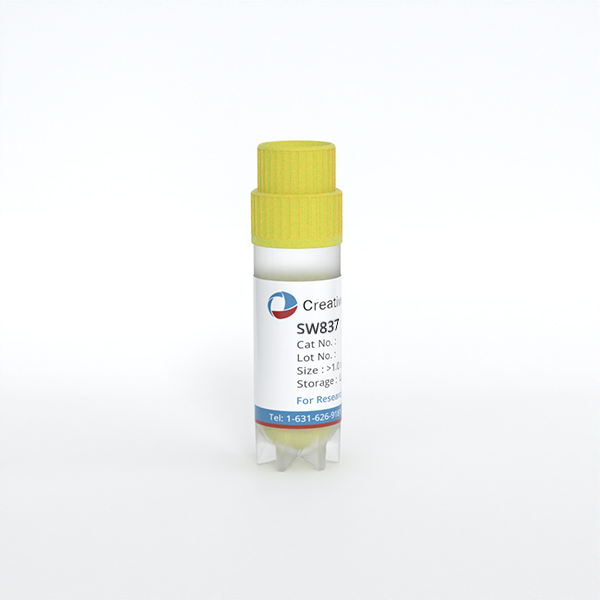
SW837
Cat.No.: CSC-6317W
Species: Homo sapiens (Human)
Source: Rectum
Morphology: continuous culture, grown as monolayer, morphology epithelial-like
Culture Properties: monolayer
- Specification
- Background
- Scientific Data
- Q & A
- Customer Review
Tissue: rectum;
Tumor: adenocarcinoma, grade IV
SW837 is a human colorectal cancer cell line originally established from a rectal adenocarcinoma tumor sample of a male patient. It is a model for an advanced colorectal malignancy and is often used as an in vitro model for the study of rectal and colorectal cancer biology. In culture, SW837 cells form an adherent monolayer with an epithelial-like appearance and exhibit stable proliferation in standard culture conditions and is typically maintained in Leibovitz's L-15 or DMEM culture medium with fetal bovine serum supplementation. SW837 cells carry molecular alterations that are known to be oncogenic in colorectal cancer, including activating mutations in KRAS and alterations in the TP53 tumor suppressor pathway. The presence of these mutations results in aberrant activation of pathways controlling cell proliferation, survival, and anti-apoptotic mechanisms, providing a platform to model cellular and molecular processes in colorectal cancer. The cell line also exhibits karyotypic changes that are common in advanced colorectal carcinomas.
In terms of cellular function, SW837 cells exhibit malignant characteristics, such as enhanced proliferation, dysregulated signaling pathways, and sensitivity to chemotherapeutic drugs and targeted inhibitors. SW837, which is dependent on MAPK signaling due to the mutant KRAS, is used to model the impact of MAPK modulation, drug resistance and the testing of inhibitors in colorectal cancer, as well as studies on tumor metabolism, invasion and biomarker discovery.
VASN Promotes CRC Cell Migration, Invasion, Proliferation, and Drug Resistance In Vitro
LARC patients commonly receive adjuvant therapy, however, hidden micrometastases still limit the improvement of OS. Kang's team aims to investigate the impact of VASN in rectal cancer with pulmonary metastasis and understand the underlying molecular mechanisms to guide adjuvant chemotherapy selection.
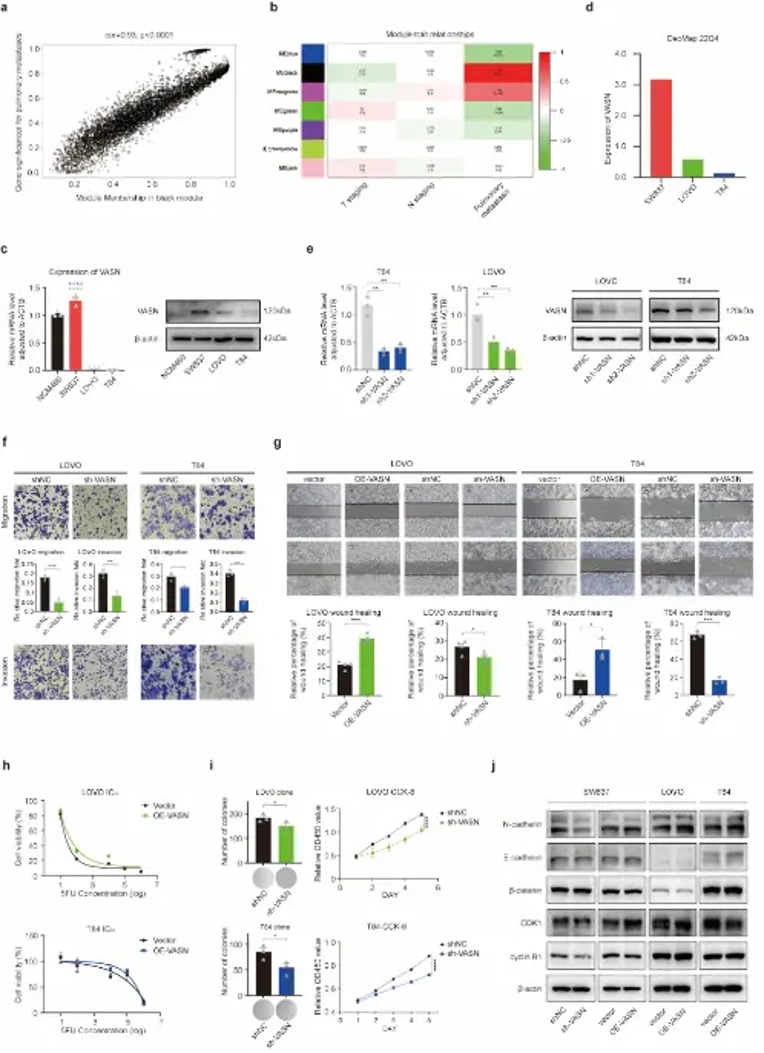
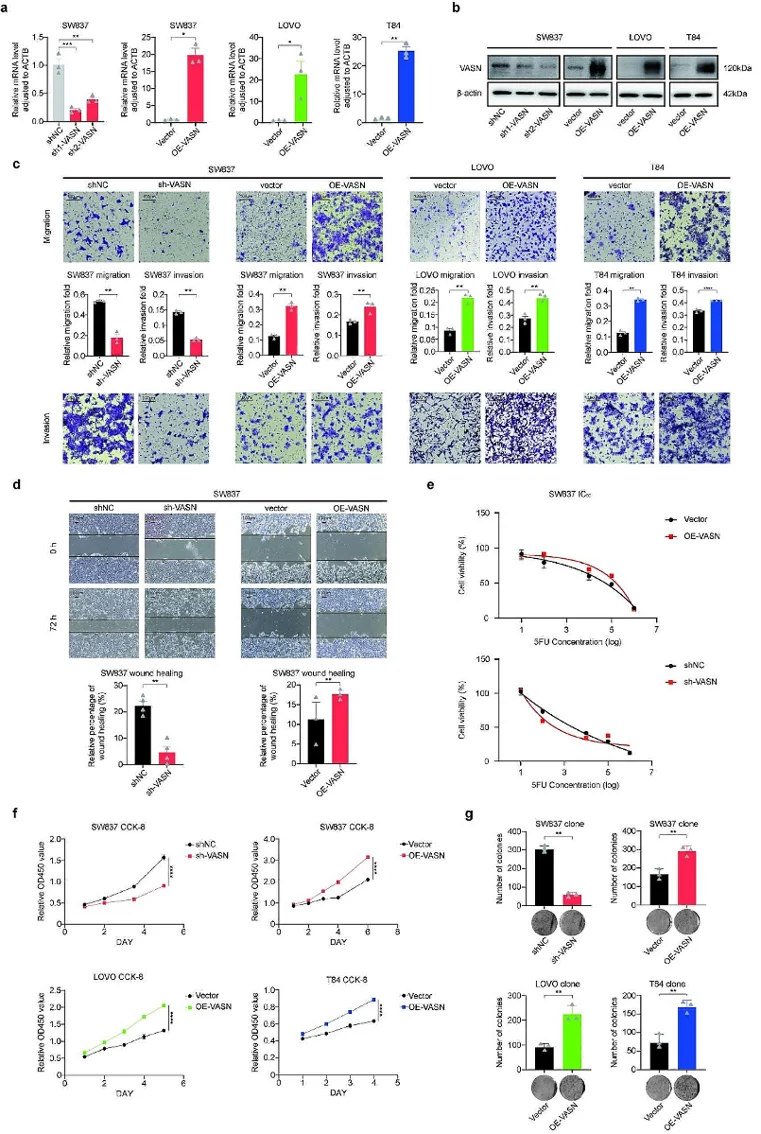
The expression levels of VASN in different colorectal cancer (CRC) cell lines were examined. The results showed that VASN expression was higher in rectal cancer cell line SW837 than in colon cancer cell lines LOVO and T84 (Fig. 1c). Subsequently, a stable cell line with VASN overexpression or knockdown was constructed and its expression was verified (Fig. 2a, b; Fig. 1e). The Transwell assay revealed that overexpression of VASN enhanced the migration and invasion of CRC cells (Fig. 2c; Fig. 1f), while knockdown of VASN attenuated these effects. Similar effects were also observed in the wound healing experiment (Fig. 2d; Fig. 1g). The IC50 value indicated that VASN overexpression decreased sensitivity to 5-FU, while knockdown increased it (Fig. 2e; Fig. 1h). CCK-8 and colony formation assays showed that VASN overexpression promoted CRC cell proliferation (Fig. 2f, g; Fig. 1i). Western blot and flow cytometry analyses revealed changes in related proteins and cell cycle phases (Fig. 1j). Overall, VASN acts as an oncogene in CRC, promoting cell proliferation and tumorigenesis.
Ask a Question
Write your own review
- You May Also Need
Description: Established from an adenocarcinoma located in the ascending colon of a 68 year-old male patient. The adenocarcinoma was well differentiated and determined to be Dukes' stage B. Imperial College ...
Description: This is one cell line out of a series of colon carcinoma cell lines established by PD Dr. Michael Linnebacher.
Description: Rectal carcinoma from a Japanese patient. Cell growth is slow.
Description: The C80 cell line was established from a 69-year old male patient with a moderately well differentiated adenocarcinoma of the rectum classified as Dukes' stage D.
Description: RKO is a poorly differentiated colon carcinoma cell line developed by Michael Brattain.
- Adipose Tissue-Derived Stem Cells
- Human Neurons
- Mouse Probe
- Whole Chromosome Painting Probes
- Hepatic Cells
- Renal Cells
- In Vitro ADME Kits
- Tissue Microarray
- Tissue Blocks
- Tissue Sections
- FFPE Cell Pellet
- Probe
- Centromere Probes
- Telomere Probes
- Satellite Enumeration Probes
- Subtelomere Specific Probes
- Bacterial Probes
- ISH/FISH Probes
- Exosome Isolation Kit
- Human Adult Stem Cells
- Mouse Stem Cells
- iPSCs
- Mouse Embryonic Stem Cells
- iPSC Differentiation Kits
- Mesenchymal Stem Cells
- Immortalized Human Cells
- Immortalized Murine Cells
- Cell Immortalization Kit
- Adipose Cells
- Cardiac Cells
- Dermal Cells
- Epidermal Cells
- Peripheral Blood Mononuclear Cells
- Umbilical Cord Cells
- Monkey Primary Cells
- Mouse Primary Cells
- Breast Tumor Cells
- Colorectal Tumor Cells
- Esophageal Tumor Cells
- Lung Tumor Cells
- Leukemia/Lymphoma/Myeloma Cells
- Ovarian Tumor Cells
- Pancreatic Tumor Cells
- Mouse Tumor Cells