
SW1990
Cat.No.: CSC-C8214L
Species: Homo sapiens (Human)
Source: Pancreas
Morphology: Epithelial
Culture Properties: Adherent
- Specification
- Background
- Scientific Data
- Q & A
- Customer Review
D13S317: 8, 12
D7S820: 9, 10
D16S539: 13
vWA: 17
THO1: 9.3
Amelogenin: X
TPOX: 8, 9
CSF1PO: 10, 12
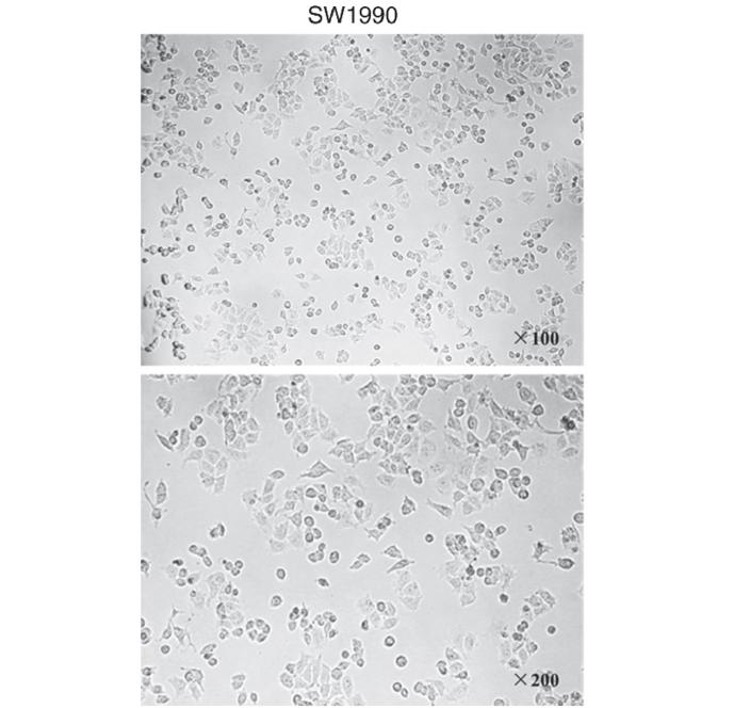
SW1990 is a human pancreatic adenocarcinoma cell line that was derived from a spleen metastasis of a grade II pancreatic ductal cancer, taken from a 56 years old Caucasian male, in 1978. Under routine microscopy, the cells have a typical epithelial, adherent morphology, polygonal to cobblestone in shape, with a well-defined nucleus (see Product Manual). Genomic sequencing of SW1990 reveals homozygous KRAS G12D, heterozygous TP53 and FLCN mutations, among others commonly found in pancreatic cancer.
Researchers use SW1990 extensively to study pancreatic cancer characteristics and therapies. It has been used as a model of proliferation, invasion, and metastasis as well as in screening chemotherapeutics, including gemcitabine, paclitaxel, and new targeted therapeutics. The line has been used to generate cancer stem cell spheroids and xenograft tumors in nude mice, which can be used as drug screens or in mechanistic studies of important pancreatic cancer pathways such as KRAS, Hedgehog and EMT. Reporter derivatives (eGFP, luciferase) have been generated for in vivo imaging of tumor growth and therapeutic response. SW1990's well defined genetics, robust and stable growth characteristics, and established use make it a useful tool for understanding pancreatic cancer biology and for preclinical drug development.
G-6 Combined with GEM Inhibited the Growth of SW1990 Cells
Pancreatic cancer has a dismal prognosis; gemcitabine (GEM), the standard chemotherapy, shows limited efficacy. Zheng's team previously isolated the novel sesquiterpenoid G-6 (nardoguaianone L) with anti-pancreatic cancer activity. They therefore asked whether G-6 can sensitize SW1990 pancreatic cancer cells to GEM and explored the underlying mechanism.
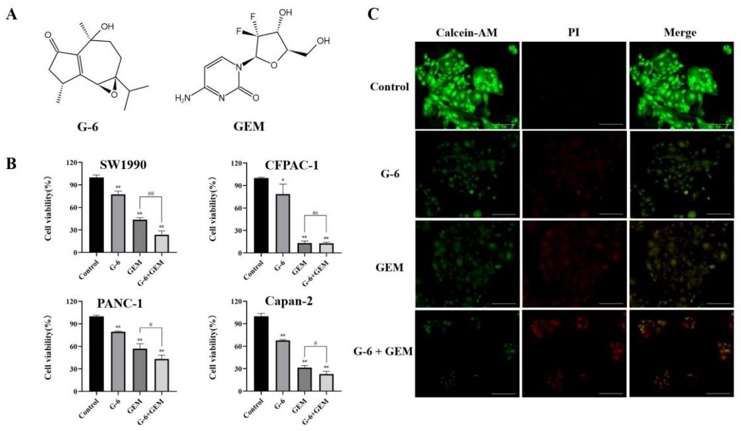
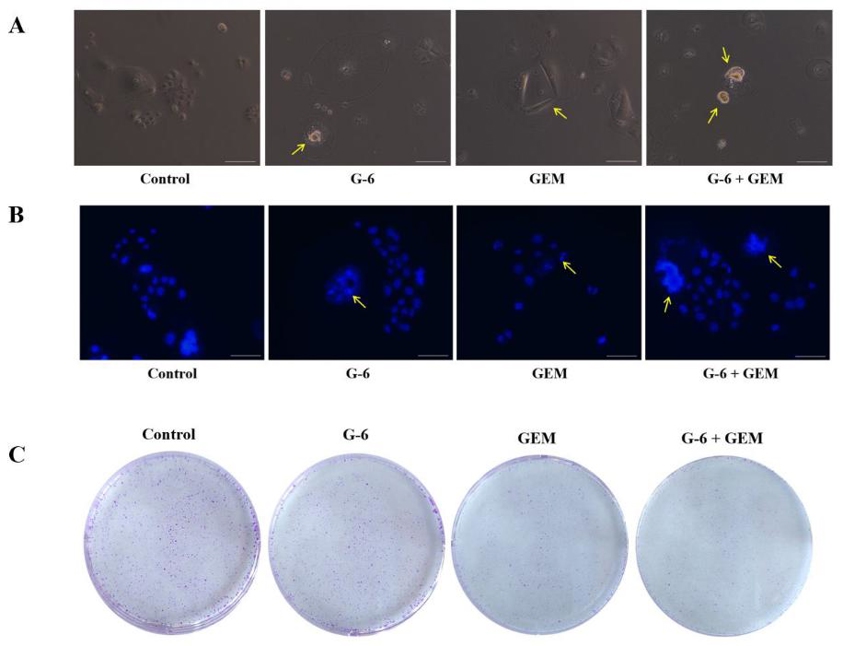
The chemical structures of G-6 and GEM are shown in Figure 1A. In order to study the toxicity of G-6 combined with GEM against pancreatic cancer cells, the MTT assay was carried out. SW1990, CFPAC-1, Capan-2, and PANC-1 cells are all derived from the human body and have an epithelioid morphology with a high degree of malignancy. MTT assays showed G-6+GEM was most potent against SW1990 (1.35- to 3.39-fold increase in inhibition), modest against Capan-2 and PANC-1, and ineffective on CFPAC-1 (Fig. 1B); SW1990 was therefore chosen for follow-up. Calcein/PI co-staining revealed progressive loss of live (green) and gain of dead (red) cells, confirming the combination's cytotoxicity (Fig. 1C). Microscopy and colony assays showed G-6+GEM suppressed SW1990 growth. Control cells were plump with evenly stained nuclei; after combination, cells appeared bright and granular, with condensed chromatin and shrunken nucleoli (Fig. 2A, B). Colony counts were markedly lower than with single agents or control (Fig. 2C).
The Antitumor Activity of a Co-Assembly Gel with Natural Carrier-Free Binary Small Molecules on SW1990 Cells
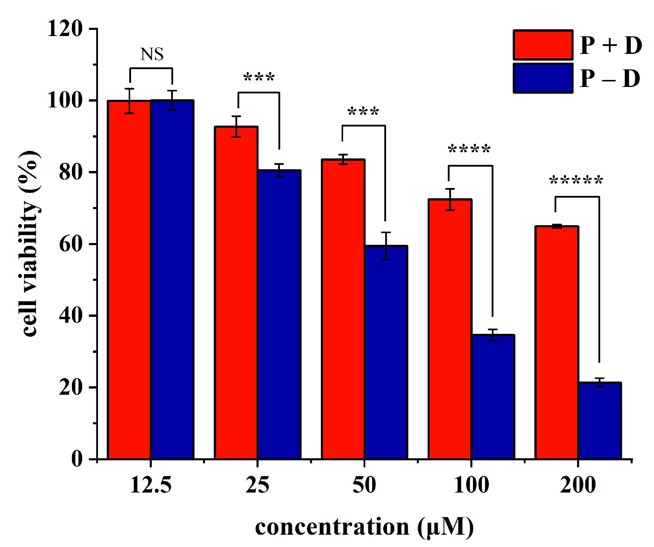
Pancreatic cancer, the "king of tumours," progresses rapidly and lacks effective therapies. PUE blocks mTOR-driven glucose metabolism and, together with the anti-inflammatory DAA, forms the basis for testing P-D gel. Cytotoxicity assay (Fig. 3) showed that up to 12.5 μM, neither free P+D nor P-D gel harmed SW1990 cells; both inhibited growth dose-dependently. P-D gel was markedly stronger: at 100 and 200 μM, cell viability fell to 34.66 % and 21.39 % versus 72.43 % and 64.95 % with P+D. Enhanced uptake, lysosomal escape, and sustained release are thought to amplify the synergistic small-molecule pair, echoing TCM compatibility theory.
Ask a Question
Write your own review
- You May Also Need
Description: Human moderately differentiated adenocarcinoma cell line established from liver metastasis.
Description: Established in 1985 from the primary ductal pancreatic adenocarcinoma (grade II) from a 44-year-old woman; reported as inducing metastasis in nude mice and as secreting proteinases (e.g. urokinase, ...
Description: established from the pancreas of a 81-year-old male patient with pancreatic ductal adenocarcinoma
Description: The MIA PaCa-2 cell line was established from tumor tissue of the pancreas obtained from a 65-year-old Caucasian male in 1975 by A. Yunis, et al. These cells are described to express human colony ...
Description: Established in 2010 from the pancreatic tumor of a 46-year old man with poorly differentiated ductal adenocarcinoma (high grade G3, pT3pN1)
Description: Human tumor cell line secreting parathyroid hormone-related peptide (PTHrP) established from pancreatic tumor.
- Adipose Tissue-Derived Stem Cells
- Human Neurons
- Mouse Probe
- Whole Chromosome Painting Probes
- Hepatic Cells
- Renal Cells
- In Vitro ADME Kits
- Tissue Microarray
- Tissue Blocks
- Tissue Sections
- FFPE Cell Pellet
- Probe
- Centromere Probes
- Telomere Probes
- Satellite Enumeration Probes
- Subtelomere Specific Probes
- Bacterial Probes
- ISH/FISH Probes
- Exosome Isolation Kit
- Human Adult Stem Cells
- Mouse Stem Cells
- iPSCs
- Mouse Embryonic Stem Cells
- iPSC Differentiation Kits
- Mesenchymal Stem Cells
- Immortalized Human Cells
- Immortalized Murine Cells
- Cell Immortalization Kit
- Adipose Cells
- Cardiac Cells
- Dermal Cells
- Epidermal Cells
- Peripheral Blood Mononuclear Cells
- Umbilical Cord Cells
- Monkey Primary Cells
- Mouse Primary Cells
- Breast Tumor Cells
- Colorectal Tumor Cells
- Esophageal Tumor Cells
- Lung Tumor Cells
- Leukemia/Lymphoma/Myeloma Cells
- Ovarian Tumor Cells
- Pancreatic Tumor Cells
- Mouse Tumor Cells