
- Specification
- Background
- Scientific Data
- Q & A
- Customer Review
SW 1463 Cells are human colorectal adenocarcinoma cells derived from colon primary tumor that are commonly used as an in vitro colorectal cancer (CRC) cell line. SW 1463 Cells can model epithelial-derived malignant colorectal cells and CRC tumor biology in order to understand mechanisms of tumor progression and therapeutic response.
SW 1463 Cells demonstrate adherent growth pattern with epithelial-like morphology, growing as polygonal cells and forming monolayers with tight cell-cell junctions. They express epithelial cell markers and CRC-associated antigens such as cytokeratins, epithelial cell adhesion molecule (EpCAM), and carcinoembryonic antigen (CEA), characteristics which is typical of cells derived from intestinal epithelium. SW 1463 cells also have gene alterations commonly associated with CRC which may have functional consequences on CRC signaling pathways. These cells have been used to study cell proliferation, apoptosis, migration, invasion, and tumor metabolism. Alterations present in SW 1463 cells are commonly dysregulated in CRC and have been used to study Wnt/β-catenin, PI3K/AKT, MAPK, and p53 signaling. They have been commonly used to study drug sensitivity, chemoresistance and targeted therapy.
KAN0438757 Efficiently Reduces PFKFB3 Expression in Colorectal Cancer Cells, without Reducing Its Transcriptional Regulation
Since glycolysis is a common feature of cancer, targeting glycolysis is an attractive anti-cancer strategy. One driver of glycolysis in both cancer cells and in cells of the tumor microenvironment is PFKFB3. Oilverira et al. analyzed PFKFB3 expression in rectal and colon tumors and its prognostic significance, and investigated the effects of a novel PFKFB3 inhibitor named KAN0438757 on CRC cells and patient-derived intestinal organoids.
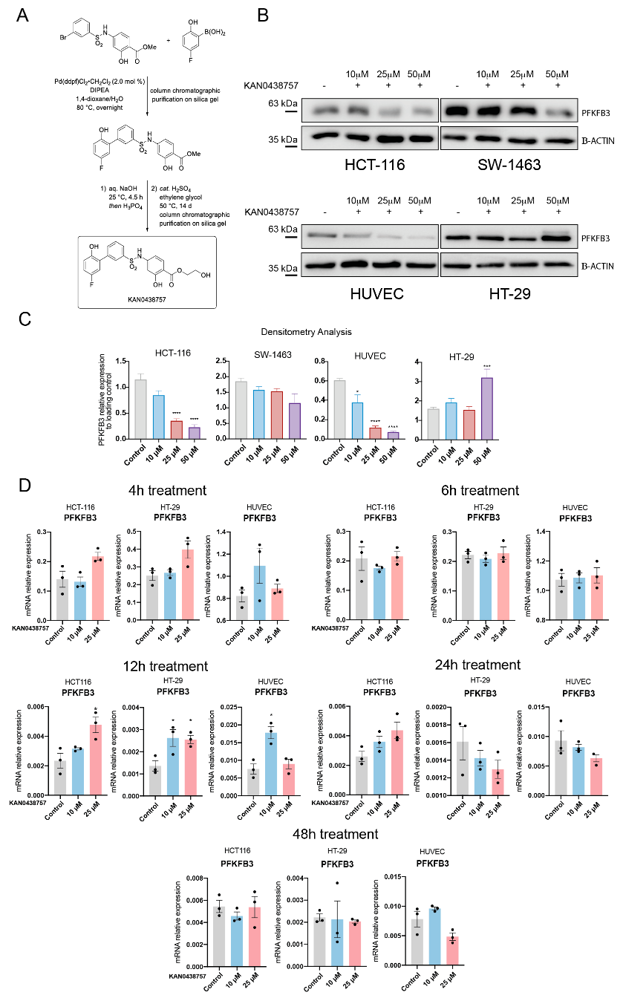
To test whether KAN0438757 (Fig. 1A) decreased the protein level of PFKFB3, human umbilical vein endothelial cells (HUVEC) and CRC cell lines (HCT-116, HT-29, and SW-1463) were treated with KAN0438757 (10, 25, or 50 μM) for 12 h. Immunoblot analysis revealed that KAN0438757 treatment decreased PFKFB3 protein expression in HCT-116, SW-1463, and HUVECs in a dose-dependent manner (Fig. 1B, C). HCT-116 cells were more susceptible to inhibition of PFKFB3 than SW-1463 cells, but interestingly HT-29 cells upregulated PFKFB3 at 50 μM. To determine if these effects were mediated through changes at the transcriptional level, HCT-116 and HT-29 cells were treated with KAN0438757 (10 or 25 μM) for 4-48 hours, and expression levels of PFKFB3 mRNA were measured by RT-PCR (Fig. 1D). Primary, low passage HUVECs were also treated with KAN0438757 because they are highly glycolytic. Overall, KAN0438757 did not reliably decrease PFKFB3 mRNA levels in HCT-116 cells or HUVECs. In contrast, there was a significant increase in PFKFB3 mRNA in HT-29 cells treated with KAN0438757 for 12 hours (10 and 25 μM), which did not correlate with protein levels (Fig. 1B, C). Taken together, these results suggest that KAN0438757 decreases PFKFB3 protein levels through a mechanism independent of transcriptional repression.
Ask a Question
Write your own review
Description: Established from an adenocarcinoma located in the ascending colon of a 68 year-old male patient. The adenocarcinoma was well differentiated and determined to be Dukes' stage B. Imperial College ...
Description: This is one cell line out of a series of colon carcinoma cell lines established by PD Dr. Michael Linnebacher.
Description: Rectal carcinoma from a Japanese patient. Cell growth is slow.
Description: The C80 cell line was established from a 69-year old male patient with a moderately well differentiated adenocarcinoma of the rectum classified as Dukes' stage D.
Description: RKO is a poorly differentiated colon carcinoma cell line developed by Michael Brattain.
- Adipose Tissue-Derived Stem Cells
- Human Neurons
- Mouse Probe
- Whole Chromosome Painting Probes
- Hepatic Cells
- Renal Cells
- In Vitro ADME Kits
- Tissue Microarray
- Tissue Blocks
- Tissue Sections
- FFPE Cell Pellet
- Probe
- Centromere Probes
- Telomere Probes
- Satellite Enumeration Probes
- Subtelomere Specific Probes
- Bacterial Probes
- ISH/FISH Probes
- Exosome Isolation Kit
- Human Adult Stem Cells
- Mouse Stem Cells
- iPSCs
- Mouse Embryonic Stem Cells
- iPSC Differentiation Kits
- Mesenchymal Stem Cells
- Immortalized Human Cells
- Immortalized Murine Cells
- Cell Immortalization Kit
- Adipose Cells
- Cardiac Cells
- Dermal Cells
- Epidermal Cells
- Peripheral Blood Mononuclear Cells
- Umbilical Cord Cells
- Monkey Primary Cells
- Mouse Primary Cells
- Breast Tumor Cells
- Colorectal Tumor Cells
- Esophageal Tumor Cells
- Lung Tumor Cells
- Leukemia/Lymphoma/Myeloma Cells
- Ovarian Tumor Cells
- Pancreatic Tumor Cells
- Mouse Tumor Cells