
OE19
Cat.No.: CSC-C9230W
Species: Homo sapiens (Human)
Source: Esophagus
Morphology: epithelial
- Specification
- Background
- Scientific Data
- Q & A
- Customer Review
OE19 is a rigorously authenticated human esophageal adenocarcinoma (EAC) cell line established in 1993 from a Stage III, moderately differentiated adenocarcinoma of the gastric cardia/esophagogastric junction. As one of only nine verified EAC lines authenticated by genotype-matched primary tissue analysis, OE19 offers exceptional model fidelity.
Molecularly, OE19 is defined by ~100-fold ERBB2 (HER2) amplification with robust protein overexpression, making it a premier preclinical model for HER2-targeted therapy evaluation. Critically, the line harbors wild-type KRAS and BRAF alongside microsatellite-stable (MSS) status, providing a clean genetic background devoid of confounding RAS/RAF-mediated resistance pathways. TP53 mutation (N310K frameshift) and preserved expression of epithelial differentiation markers (CK8/18, EpCAM, E-cadherin, MUC1) further validate its EAC identity.
Functionally, OE19 demonstrates potent tumorigenicity in immunodeficient mice, forming palpable subcutaneous xenografts within 7–10 days and reliably producing bloody ascites with liver metastasis in intraperitoneal dissemination models. Its documented sensitivity to paclitaxel and established utility in 3D culture and high-throughput drug screening platforms underscore its translational relevance. With comprehensive STR profiling and decades of peer-reviewed validation, OE19 remains the gold-standard EAC model for mechanistic studies and therapeutic development in gastroesophageal malignancies.
AGR2 Depletion and ER Stress Remodel the OE19 Secretome
The endoplasmic reticulum (ER) chaperone Anterior Gradient 2 (AGR2) is overexpressed in various adenocarcinomas, promoting tumor progression and chemoresistance. However, its exact role in modulating the Unfolded Protein Response (UPR) and remodeling the cancer cell secretome under proteotoxic stress remains poorly understood. Using shRNA-mediated silencing of AGR2 combined with high-throughput LC-MS/MS proteomic analysis in OE19 gastroesophageal junction adenocarcinoma cells, Bourgery, Quentin, et al. profiled the global changes in protein secretion under basal and tunicamycin-induced ER stress conditions.
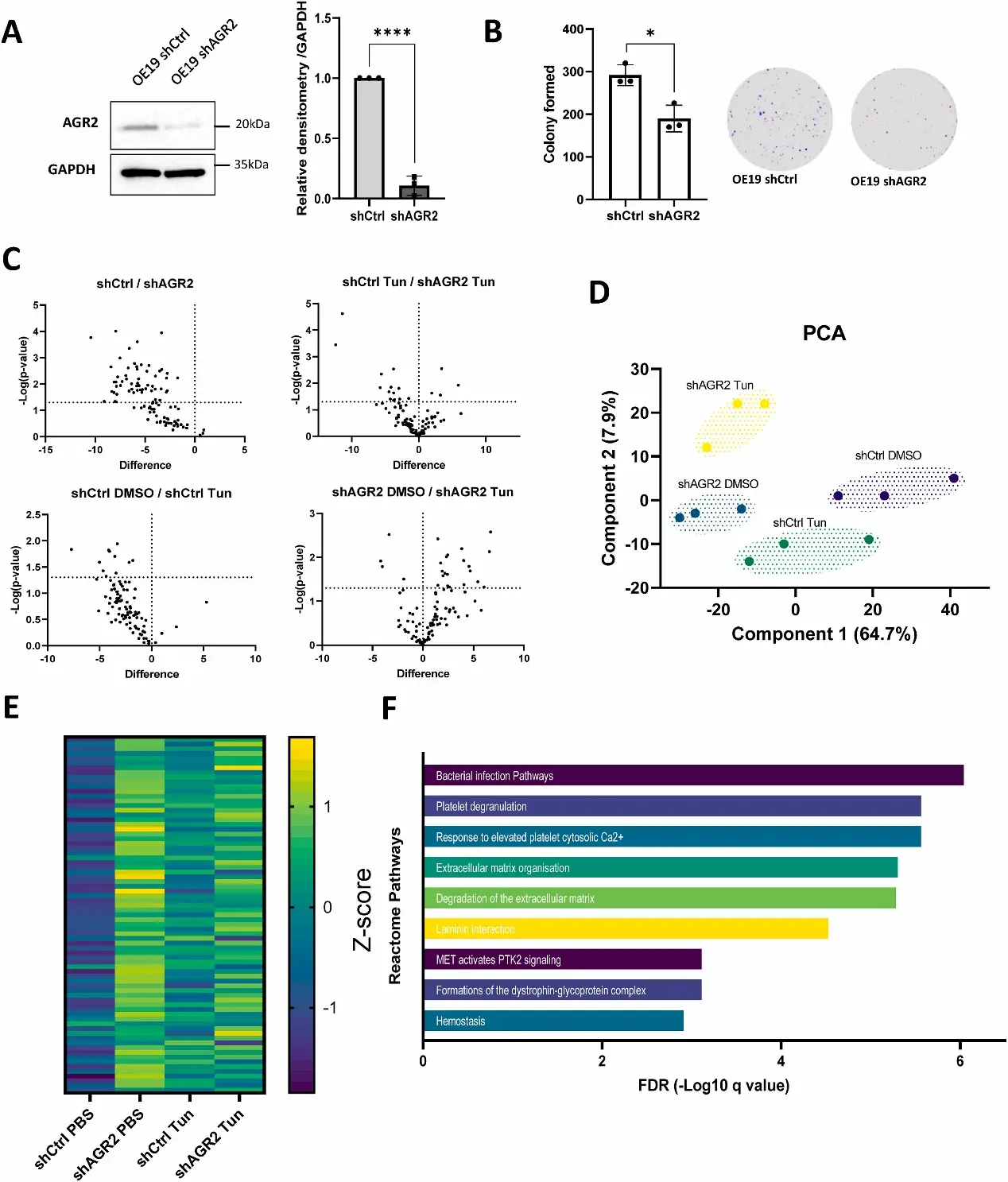
AGR2 silencing efficiency was confirmed by Western blotting (Fig. 1A), and reduced AGR2 levels also impaired clonogenic growth (Fig. 1B). Secretome profiling by LC-MS/MS of exosome-free conditioned media across four conditions (shCtrl, shAGR2, shCtrl + Tun, shAGR2 + Tun) revealed extensive remodeling of secreted protein profiles. Volcano plot analysis identified 93 differentially secreted proteins under basal conditions and between 93 and 97 under ER stress (Fig. 1C). In both conditions, AGR2 depletion was associated with a predominant increase in protein secretion relative to controls. Principal Component Analysis (PCA) showed clear segregation of the four experimental groups, indicating distinct secretory signatures associated with AGR2 status and ER stress (Fig. 1D). Heatmap analysis further illustrated the differential secretion patterns across conditions and the clustering of secreted proteins (Fig. 1E). Comparative analysis identified a core set of 75 common differentially secreted proteins across conditions. Functional enrichment analysis revealed significant enrichment of pathways involved in hemostasis and extracellular matrix organization, linking AGR2-dependent secretome changes to microenvironmental remodeling (Fig. 1F).
Ask a Question
Write your own review
- You May Also Need
Description: Human moderately differentiated squamous cell carcinoma cell line established from esophageal cancer.
Description: Human moderately differentiated squamous cell carcinoma cell line established from esophageal cancer.
Description: Human moderately differentiated squamous cell carcinoma cell line established from esophageal cancer.
Description: Human squamous cell carcinoma from oral cavity via mouse transplantation.
Description: Human squamous cell carcinoma cell line established from recurrent cancer (esophageal cancer).
- Adipose Tissue-Derived Stem Cells
- Human Neurons
- Mouse Probe
- Whole Chromosome Painting Probes
- Hepatic Cells
- Renal Cells
- In Vitro ADME Kits
- Tissue Microarray
- Tissue Blocks
- Tissue Sections
- FFPE Cell Pellet
- Probe
- Centromere Probes
- Telomere Probes
- Satellite Enumeration Probes
- Subtelomere Specific Probes
- Bacterial Probes
- ISH/FISH Probes
- Exosome Isolation Kit
- Human Adult Stem Cells
- Mouse Stem Cells
- iPSCs
- Mouse Embryonic Stem Cells
- iPSC Differentiation Kits
- Mesenchymal Stem Cells
- Immortalized Human Cells
- Immortalized Murine Cells
- Cell Immortalization Kit
- Adipose Cells
- Cardiac Cells
- Dermal Cells
- Epidermal Cells
- Peripheral Blood Mononuclear Cells
- Umbilical Cord Cells
- Monkey Primary Cells
- Mouse Primary Cells
- Breast Tumor Cells
- Colorectal Tumor Cells
- Esophageal Tumor Cells
- Lung Tumor Cells
- Leukemia/Lymphoma/Myeloma Cells
- Ovarian Tumor Cells
- Pancreatic Tumor Cells
- Mouse Tumor Cells