
Mouse Chromosome 19 Paint Probe
- Specification
- Scientific Data
- Q & A
- Customer Review
- Documents
 For Research Use Only. Not for use in diagnostic procedures.
LINE1 and PRC2 control nucleolar organization and repression of the 8C state in human ESCs
Background
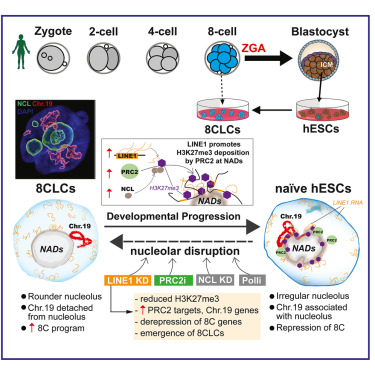
The mechanisms ensuring developmental progression in early human embryos are largely unknown. This study shows that LINE1 transposons prevent reversion of naive human embryonic stem cells (hESCs) to 8-cell-like cells (8CLCs). LINE1 RNA maintains H3K27me3 levels, especially at chromosome 19 (Chr19), which is enriched for 8C regulators. Chr19 associates with the nucleolus in hESCs but dissociates in 8CLCs. PRC2 inhibition or LINE1 knockdown induces the 8C program and nucleolar stress. Disruption of nucleolar architecture de-represses the 8C program, indicating that LINE1 RNA and PRC2 maintain gene repression and 3D nuclear organization to prevent developmental reversion.
Key Findings
1. Knockdown of LINE1 RNA in naive hESCs induces reversion to 8-cell-like cells (8CLCs), demonstrating that LINE1 acts as a barrier to the 8C state. 2. LINE1 RNA maintains H3K27me3 levels, particularly at chromosome 19 (Chr19), which is enriched for key 8C regulators. 3. Chr19 strongly associates with the nucleolus in hESCs but dissociates in 8CLCs; PRC2 inhibition also leads to Chr19 relocalization away from the nucleolus. 4. LINE1 knockdown or PRC2 inhibition induces nucleolar stress and disrupts nucleolar architecture, which is sufficient to de-repress the 8C program. 5. LINE1 RNA interacts with PRC2 components (EZH2, SUZ12) and contributes to H3K27me3 maintenance at LINE1 RNA binding sites, especially in Chr19. 6. These findings reveal that LINE1 RNA and PRC2 cooperate to maintain 3D nuclear organization and gene repression, preventing developmental reversion of hESCs.
Contribution
Creative Bioarray supplied the Chromosome 19 DNA-FISH probe (Cat# FWCP-19), enabling visualization of Chr19 territories and their nucleolar association in hESCs and 8CLCs. This probe was critical for demonstrating the dynamic relocalization of Chr19 during 8C reversion and its dissociation from the nucleolus upon PRC2 inhibition.
Ask a Question
Write your own review
 Datasheet
- Adipose Tissue-Derived Stem Cells
- Human Neurons
- Mouse Probe
- Whole Chromosome Painting Probes
- Hepatic Cells
- Renal Cells
- In Vitro ADME Kits
- Tissue Microarray
- Tissue Blocks
- Tissue Sections
- FFPE Cell Pellet
- Probe
- Centromere Probes
- Telomere Probes
- Satellite Enumeration Probes
- Subtelomere Specific Probes
- Bacterial Probes
- ISH/FISH Probes
- Exosome Isolation Kit
- Human Adult Stem Cells
- Mouse Stem Cells
- iPSCs
- Mouse Embryonic Stem Cells
- iPSC Differentiation Kits
- Mesenchymal Stem Cells
- Immortalized Human Cells
- Immortalized Murine Cells
- Cell Immortalization Kit
- Adipose Cells
- Cardiac Cells
- Dermal Cells
- Epidermal Cells
- Peripheral Blood Mononuclear Cells
- Umbilical Cord Cells
- Monkey Primary Cells
- Mouse Primary Cells
- Breast Tumor Cells
- Colorectal Tumor Cells
- Esophageal Tumor Cells
- Lung Tumor Cells
- Leukemia/Lymphoma/Myeloma Cells
- Ovarian Tumor Cells
- Pancreatic Tumor Cells
- Mouse Tumor Cells