
Human iPS Cell Line (Type 2 Diabetes)
- Specification
- Background
- Scientific Data
- Q & A
- Customer Review
Human iPS Cell Line (Type 2 Diabetes) is a disease-specific induced pluripotent stem cell (iPSC) line generated from somatic cells obtained from individuals diagnosed with Type 2 Diabetes Mellitus (T2DM). Through biological reprogramming, these cells acquire pluripotency, but preserve the genetic background and disease susceptibilities of the donor. They thus represent a great platform to explore the genetic and cellular pathways underlying the pathophysiology of T2DM.
These cells have high self-renewal potential and, in addition, can be differentiated into a wide range of metabolically relevant cell types including pancreatic β cells, hepatocytes, adipocytes, skeletal muscle cells, endothelial cells and other tissues involved in glucose homeostasis. The human iPS cell lines produced from T2DM patients are commonly utilized to study the insulin resistance, β-cell malfunction, poor glucose metabolism, and genetic variables contributing to the disease progression.
Besides disease modeling, these cells are important instruments for drug discovery, toxicity testing, biomarker finding and personalized medicine studies. Also enabling the construction of patient-specific in vitro models for researching diabetic consequences such as retinopathy, nephropathy, neuropathy and cardiovascular disease. Moreover, T2DM-derived iPSCs are rapidly being used in the field of regenerative medicine and cell therapy research to generate functional insulin-producing cells. They are an important resource for diabetes research and therapy development, as they are able to replicate patient-specific disease characteristics.
Phosphoproteomic Analysis of Cell-Intrinsic Insulin Resistance in Type 2 Diabetes–Derived iPSC-Hepatocytes
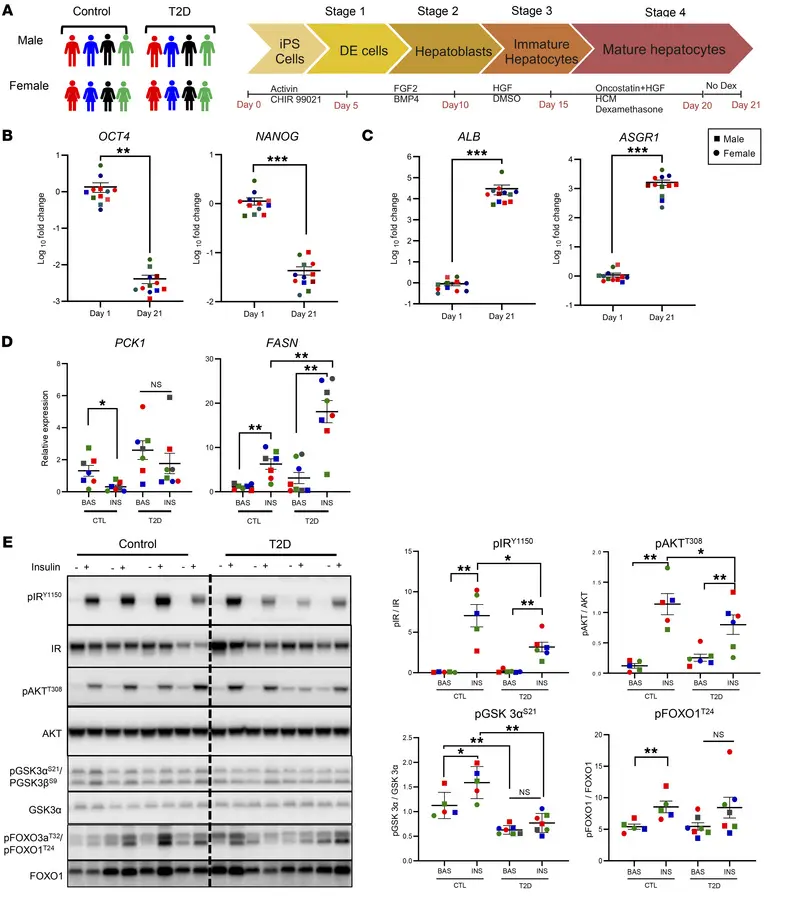
Hepatic insulin resistance is a hallmark of type 2 diabetes (T2D), but distinguishing cell-intrinsic defects from systemic metabolic influences is challenging in vivo. Gattu et al. differentiated induced pluripotent stem cells (iPSCs) from control and T2D donors into hepatocyte-like cells (iHeps) to model intrinsic hepatic insulin signaling defects.
T2D iHeps exhibited pathway-selective insulin resistance: insulin failed to suppress gluconeogenic genes (PCK1, G6PC) but retained the ability to induce lipogenic enzymes (FASN, ACACA) and showed a 1.5‑fold increase in de novolipogenesis (Fig. 1). Insulin-stimulated phosphorylation of IRβ(Y1150/1151), AKT(T308), GSK3α/β, and FOXO1/3a was reduced by 30–50% in T2D iHeps. Unbiased LC‑MS/MS phosphoproteomics identified 1,710 insulin-regulated phosphosites (|FC| > 1.5, adj. p< 0.05): 43% showed impaired insulin regulation in T2D, whereas 57% displayed emergent (gain-of-function) insulin-regulated phosphorylation. Impaired signaling involved the IRS→AKT cascade, Rho‑GTPase, Notch‑HLH, and IFN‑stimulated gene pathways, linked to reduced AKT2/3, PKCθ, CHK2, PHKG2, and STK32C activity. Emergent signaling involved Rho‑GTPase components, RNA metabolism, membrane trafficking, and chromatin modifiers, associated with increased ROCK1/2, MST4, and BCKDK activity.
These findings reveal a bipartite phosphoproteomic signature of hepatic insulin resistance—combined loss and paradoxical gain of insulin-regulated phosphorylation—driven by altered upstream kinase activities. This cell‑intrinsic model provides mechanistic insight into T2D pathophysiology and nominates new kinase targets for therapeutic intervention.
Ask a Question
Write your own review
- Adipose Tissue-Derived Stem Cells
- Human Neurons
- Mouse Probe
- Whole Chromosome Painting Probes
- Hepatic Cells
- Renal Cells
- In Vitro ADME Kits
- Tissue Microarray
- Tissue Blocks
- Tissue Sections
- FFPE Cell Pellet
- Probe
- Centromere Probes
- Telomere Probes
- Satellite Enumeration Probes
- Subtelomere Specific Probes
- Bacterial Probes
- ISH/FISH Probes
- Exosome Isolation Kit
- Human Adult Stem Cells
- Mouse Stem Cells
- iPSCs
- Mouse Embryonic Stem Cells
- iPSC Differentiation Kits
- Mesenchymal Stem Cells
- Immortalized Human Cells
- Immortalized Murine Cells
- Cell Immortalization Kit
- Adipose Cells
- Cardiac Cells
- Dermal Cells
- Epidermal Cells
- Peripheral Blood Mononuclear Cells
- Umbilical Cord Cells
- Monkey Primary Cells
- Mouse Primary Cells
- Breast Tumor Cells
- Colorectal Tumor Cells
- Esophageal Tumor Cells
- Lung Tumor Cells
- Leukemia/Lymphoma/Myeloma Cells
- Ovarian Tumor Cells
- Pancreatic Tumor Cells
- Mouse Tumor Cells