
Bovine Adipose-derived Mesenchymal Stem Cells
- Specification
- Background
- Scientific Data
- Q & A
- Customer Review
Bovine adipose-derived mesenchymal stem cells (bADMSCs) represent a highly promising and clinically relevant cell population for veterinary regenerative medicine, agricultural biotechnology, and comparative translational research.
A principal strength of bADMSCs is the abundance and accessibility of their source tissue. Adipose tissue yields significantly higher cell numbers per gram than bone marrow aspirates, while procurement via minimally invasive collection—such as from the tailhead region—eliminates the need for general anesthesia and reduces donor-site morbidity, procedural risk, and overall cost. Following isolation, bADMSCs demonstrate robust in vitro proliferative capacity and sustained self-renewal potential, enabling efficient expansion to therapeutic quantities without reliance on exogenous growth factor supplementation.
Phenotypically, bADMSCs conform to established international criteria, expressing characteristic mesenchymal surface markers including CD90, CD44, CD73, and CD105, while remaining negative for hematopoietic lineage markers such as CD45. Functionally, they retain multilineage differentiation capacity, readily differentiating into osteogenic, adipogenic, and chondrogenic lineages, with accumulating evidence supporting broader plasticity across germ layers.
Critically, bADMSCs exert potent immunomodulatory and reparative effects primarily through paracrine mechanisms. They secrete a repertoire of bioactive factors—including indoleamine 2,3-dioxygenase (IDO), prostaglandin E₂ (PGE₂), interleukin-10 (IL-10), and transforming growth factor-β1 (TGF-β1)—that collectively suppress pro-inflammatory immune cell activity, modulate macrophage polarization, and promote regulatory T-cell proliferation. Combined with their non-tumorigenic profile and hypoimmunogenic nature, these attributes render bADMSCs a versatile, scalable, and translationally attractive platform for autologous and allogeneic cell-based therapies in bovine health management.
Development of a Sustainable Strategy for Cultured Fat Production Based on Serum-Free 3D Culture of Bovine Adipose Stem Cells
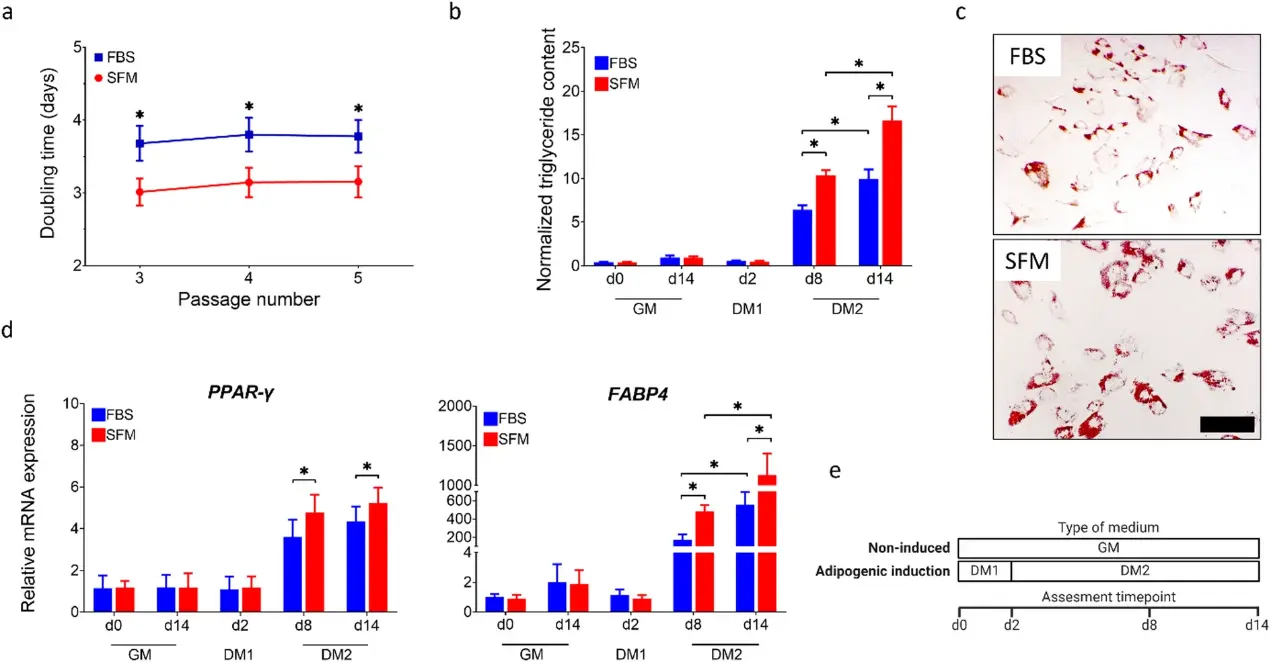
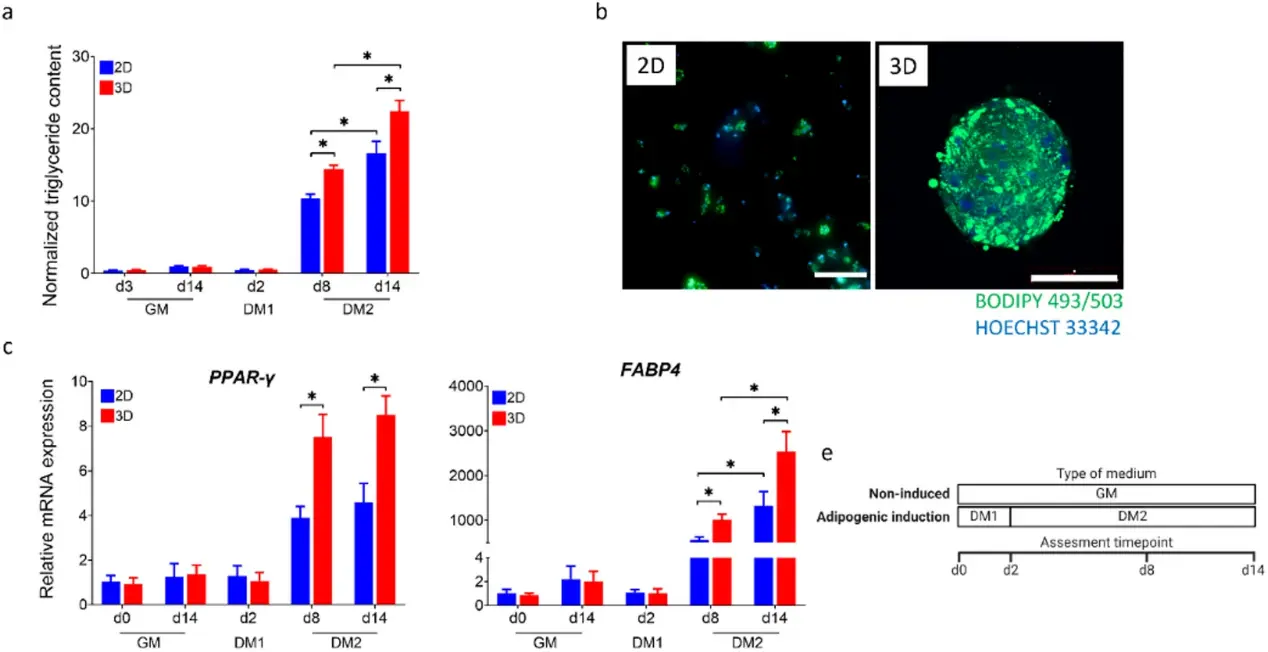
Cultivated meat provides a sustainable and ethical alternative to traditional livestock production, addressing global challenges in meat demand and environmental impact. Fat is recognized as an essential component of meat products, but strategies for culturing animal fat precursors still have major limitations, such as the need for a serum-containing medium and inefficient adipogenic cell maturation. In this study, a serum-free medium (SFM) formulation for the cultivation of bovine adipose-derived stem cells (bASC) was first validated by comparison with serum-containing media (FBS). After a 14-day induction period, the SFM increased bASC proliferation by 20% and triglyceride accumulation by 66%. When the SFM was applied to a three-dimensional (3D) spheroid culture system, it resulted in up to 34% higher triglyceride accumulation compared to 2D cultures. These results were accompanied by a significant increase in the expression of key adipogenic markers and lipid droplet formation, suggesting a synergistic potential of SFM and 3D spheroid strategies for bASC culture. Overall, these results provide a scalable and sustainable platform for cultured fat production and are an important step towards overcoming some of the challenges in cultured meat production.
Ask a Question
Write your own review
- Adipose Tissue-Derived Stem Cells
- Human Neurons
- Mouse Probe
- Whole Chromosome Painting Probes
- Hepatic Cells
- Renal Cells
- In Vitro ADME Kits
- Tissue Microarray
- Tissue Blocks
- Tissue Sections
- FFPE Cell Pellet
- Probe
- Centromere Probes
- Telomere Probes
- Satellite Enumeration Probes
- Subtelomere Specific Probes
- Bacterial Probes
- ISH/FISH Probes
- Exosome Isolation Kit
- Human Adult Stem Cells
- Mouse Stem Cells
- iPSCs
- Mouse Embryonic Stem Cells
- iPSC Differentiation Kits
- Mesenchymal Stem Cells
- Immortalized Human Cells
- Immortalized Murine Cells
- Cell Immortalization Kit
- Adipose Cells
- Cardiac Cells
- Dermal Cells
- Epidermal Cells
- Peripheral Blood Mononuclear Cells
- Umbilical Cord Cells
- Monkey Primary Cells
- Mouse Primary Cells
- Breast Tumor Cells
- Colorectal Tumor Cells
- Esophageal Tumor Cells
- Lung Tumor Cells
- Leukemia/Lymphoma/Myeloma Cells
- Ovarian Tumor Cells
- Pancreatic Tumor Cells
- Mouse Tumor Cells