
Human Dental Pulp Stem Cells
- Specification
- Background
- Scientific Data
- Q & A
- Customer Review
Applications:
Toxicology/drug screening
Regenerative medicine/dentistry/cell therapy
Muscular Dystrophy
Corneal replacement therapy
Cardiovascular disease
Comparative stem cell research
Cryopreserved Dental Pulp Stem Cells (DPSC) are guaranteed through 10 population doublings, to express CD105, CD166, CD29, CD90, and CD73, and to not express CD34, CD45, and CD133. All cells test negative for mycoplasma, bacteria, yeast, and fungi. HIV-1, hepatitis B and hepatitis C are not detected for all donors and/or cell lots. A Certificate of Analysis is provided for each cell lot purchased.
Human Dental Pulp Stem Cells (hDPSCs) are an elite population of mesenchymal stem cells (MSCs) derived from the perivascular niche of the dental pulp. Originating from the ectomesenchyme (cranial neural crest), hDPSCs possess a unique developmental plasticity that bridges the gap between conventional mesodermal MSCs and neural progenitor cells. This distinct lineage makes them one of the most versatile and potent tools in the current landscape of regenerative medicine and cell-based therapies.
- Exceptional Proliferative & Clonogenic Potential: hDPSCs exhibit significantly higher proliferation rates and a more robust doubling capacity compared to bone marrow-derived MSCs (BMSCs). This "youthful" cellular state allows for extensive ex vivo expansion without immediate loss of stemness, ensuring high-yield production for industrial applications.
- Superior Neuro-Odontogenic Plasticity: Given their neural crest origin, hDPSCs demonstrate a remarkable innate ability to differentiate into functional odontoblasts and neural-lineage cells (neurons and glia). This renders them an ideal substrate for treating neurodegenerative diseases, spinal cord injuries, and complex craniofacial defects.
- Potent Immunomodulatory & Angiogenic Secretome: hDPSCs exert strong paracrine effects by secreting high levels of pro-regenerative factors, including VEGF, IGF, and BDNF. Their ability to modulate T-cell responses and promote neovascularization makes them highly effective in treating inflammatory disorders and ischemic conditions.
- Ethically Sound & Minimally Invasive Access: Unlike embryonic stem cells or bone marrow aspirates, hDPSCs can be non-invasively harvested from discarded biological materials, such as third molars (wisdom teeth). This provides a continuous, ethically unburdened source of high-quality human stem cells.
Our Human Dental Pulp Stem Cells are rigorously characterized for MSC markers (CD73+, CD90+, CD105+) and multi-lineage competency. By providing a standardized, high-potency cell system, this product offers a superior alternative for pharmaceutical R&D, tissue engineering, and the development of next-generation regenerative therapeutics.
ECM Remodeling by PDGFRβ+ Dental Pulp Stem Cells Drives Angiogenesis and Pulp Regeneration
This study investigates the role of PDGFRβ+ dental pulp stem cells (DPSCs) in dental pulp vascular development by remodeling the extracellular matrix (ECM), with implications for angiogenesis and pulp regeneration using GelMA hydrogels.
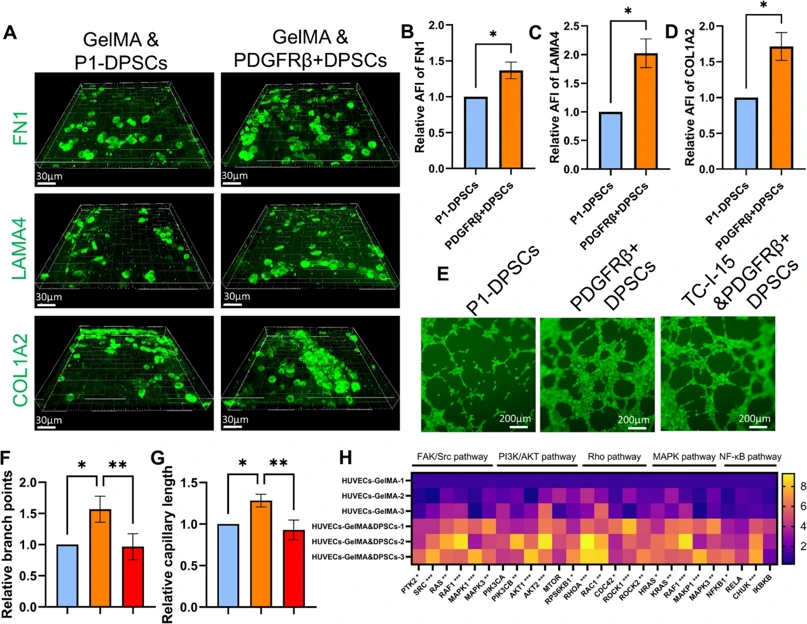
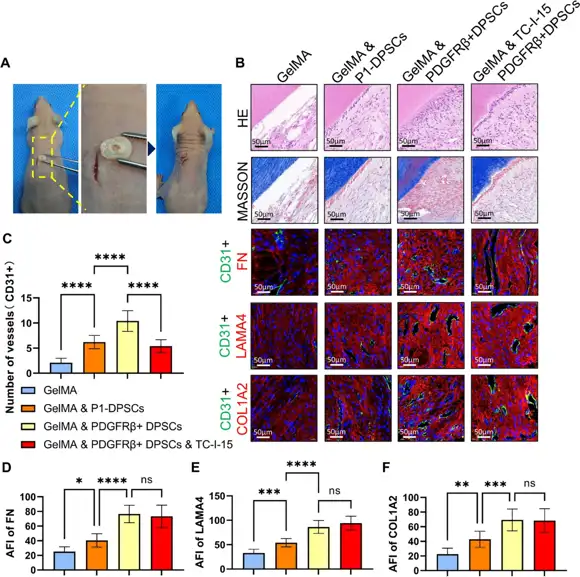
PDGFRβ+ DPSCs were assessed for ECM remodeling and angiogenesis via secretion of ECM proteins (FN, LAMA4, COL1A2). Immunofluorescence and gene expression analyses were performed to evaluate ECM composition and related signaling pathways. GelMA hydrogels loaded with PDGFRβ+ DPSCs were tested for angiogenic support in vitro (HUVEC tube formation) and in vivo (subcutaneous implantation in mice for 6 weeks).
PDGFRβ+ DPSCs enhanced ECM deposition and modulated angiogenic signaling, promoting vascular development. Encapsulation in GelMA hydrogels supported HUVEC tube formation and facilitated organized pulp-like tissue with increased ECM and angiogenesis in vivo. Integrin pathway inhibition diminished these effects, highlighting the importance of ECM-integrin signaling in angiogenesis.
Ask a Question
Write your own review
- You May Also Need
- Adipose Tissue-Derived Stem Cells
- Human Neurons
- Mouse Probe
- Whole Chromosome Painting Probes
- Hepatic Cells
- Renal Cells
- In Vitro ADME Kits
- Tissue Microarray
- Tissue Blocks
- Tissue Sections
- FFPE Cell Pellet
- Probe
- Centromere Probes
- Telomere Probes
- Satellite Enumeration Probes
- Subtelomere Specific Probes
- Bacterial Probes
- ISH/FISH Probes
- Exosome Isolation Kit
- Human Adult Stem Cells
- Mouse Stem Cells
- iPSCs
- Mouse Embryonic Stem Cells
- iPSC Differentiation Kits
- Mesenchymal Stem Cells
- Immortalized Human Cells
- Immortalized Murine Cells
- Cell Immortalization Kit
- Adipose Cells
- Cardiac Cells
- Dermal Cells
- Epidermal Cells
- Peripheral Blood Mononuclear Cells
- Umbilical Cord Cells
- Monkey Primary Cells
- Mouse Primary Cells
- Breast Tumor Cells
- Colorectal Tumor Cells
- Esophageal Tumor Cells
- Lung Tumor Cells
- Leukemia/Lymphoma/Myeloma Cells
- Ovarian Tumor Cells
- Pancreatic Tumor Cells
- Mouse Tumor Cells