
Human CD34+Hematopoietic Stem Cells (HHSC-CD34+)
- Specification
- Background
- Scientific Data
- Q & A
- Customer Review
Cell Features:
HHSC-CD34+ are cryopreserved upon isolation and purification.
HHSC-CD34+ are extensively tested for quality and optimal performance.
Creative Bioarray guarantees performance and quality.
Human CD34⁺ Hematopoietic Stem Cells (HHSC-CD34⁺) are primary human hematopoietic stem and progenitor cells typically isolated from bone marrow, mobilized peripheral blood, or umbilical cord blood. These cells are identified by the expression of the surface marker CD34, which is a well-recognized marker of hematopoietic stem and early progenitor cells. CD34⁺ cells are characterized by their intrinsic properties of self-renewal and multilineage differentiation potential, allowing them to give rise to all mature blood cell lineages, including myeloid, erythroid, and lymphoid lineages.
HHSC-CD34⁺ cells are generally non-adherent, maintained in suspension culture, and require precisely regulated cytokine and growth factor conditions to maintain stemness or induce lineage-specific differentiation. They express key stem cell and progenitor cell markers, including CD34, CD38 (variable), CD90, and CD133, and are negative for markers of terminally differentiated blood cells. Their functional characteristics closely resemble the in vivo behavior of hematopoietic cells.
HHSC-CD34⁺ cells are extensively used in basic and translational research to model and study hematopoiesis, stem cell biology, and immune system development. These cells also serve as a critical platform for gene editing, viral transduction, and the development of cell-based therapies, such as hematopoietic stem cell transplantation, gene therapy, and drug toxicity testing. HHSC-CD34⁺ cells have high clinical relevance and are widely used in regenerative medicine and the preclinical evaluation of hematologic and immunologic therapies.
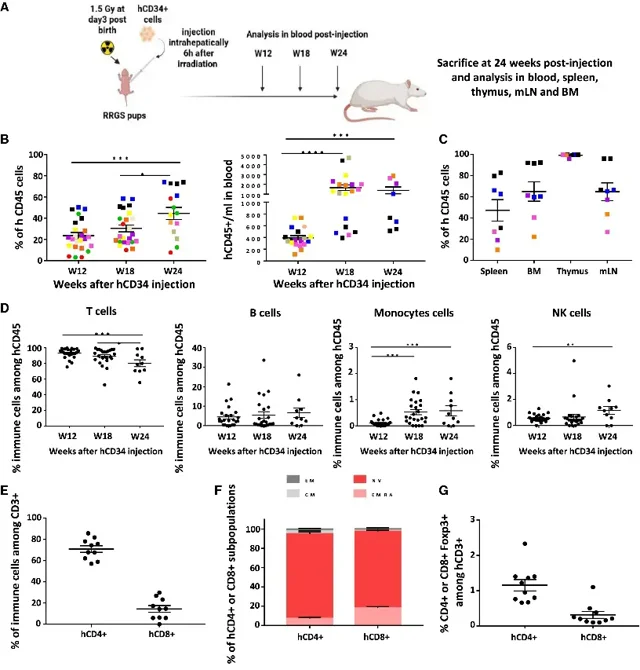
Efficient Generation of Human Immune System Rats using Human CD34⁺ Cells
Human immune system (HIS) mice are crucial for evaluating human immunotherapies but have limitations. Rats, with their larger size and comprehensive immune system, offer advantages for translational research. Ménoret et al. presents an efficient method for generating HIS rats using human CD34⁺ hematopoietic stem cells, aiming to enhance translational immunology studies.
RRGS newborns received intrahepatic hCD34⁺ cell injections (Fig. 1A). At 12 weeks, all recipients had >3% hCD45⁺ cells in PBMCs (23.6% ± 2.9%). This rose to 30.4% ± 3.2% at 18 weeks and 44.6% ± 5.7% at 24 weeks (Fig. 1B left). Absolute hCD45⁺ cell numbers also increased (Fig. 1B right). At 24 weeks, hCD45⁺ cell percentages were similar in spleen (47.2% ± 10.1%) and blood (44.6% ± 5.7%), and higher in bone marrow (65% ± 9.1%), thymus (99.2% ± 0.5%), and mesenteric lymph nodes (64.8% ± 8.3%) (Fig. 1C). Subset analysis showed mostly T cells (52%–98%) with a slight 24-week decrease (hCD3⁺, 80.4% ± 4.4%). B cells were stable (up to 25%). Monocytes and NK cells increased over time (up to 1.8% and 1.9%, respectively) (Fig. 1D). At 24 weeks, T CD4⁺ and CD8⁺ cells in PBMCs were 70.9% ± 3.1% and 14.4% ± 3.2%, respectively (Fig. 1E). Both CD4⁺ and CD8⁺ T cell subsets included various memory cells (Fig. 1F). FOXP3⁺CD4⁺ and FOXP3⁺CD8⁺ cells were 1.15% ± 0.2% and 0.3% ± 0.1%, respectively (Fig. 1G). Humanization was similar in male and female RRGS recipients.
Ask a Question
Write your own review
- Adipose Tissue-Derived Stem Cells
- Human Neurons
- Mouse Probe
- Whole Chromosome Painting Probes
- Hepatic Cells
- Renal Cells
- In Vitro ADME Kits
- Tissue Microarray
- Tissue Blocks
- Tissue Sections
- FFPE Cell Pellet
- Probe
- Centromere Probes
- Telomere Probes
- Satellite Enumeration Probes
- Subtelomere Specific Probes
- Bacterial Probes
- ISH/FISH Probes
- Exosome Isolation Kit
- Human Adult Stem Cells
- Mouse Stem Cells
- iPSCs
- Mouse Embryonic Stem Cells
- iPSC Differentiation Kits
- Mesenchymal Stem Cells
- Immortalized Human Cells
- Immortalized Murine Cells
- Cell Immortalization Kit
- Adipose Cells
- Cardiac Cells
- Dermal Cells
- Epidermal Cells
- Peripheral Blood Mononuclear Cells
- Umbilical Cord Cells
- Monkey Primary Cells
- Mouse Primary Cells
- Breast Tumor Cells
- Colorectal Tumor Cells
- Esophageal Tumor Cells
- Lung Tumor Cells
- Leukemia/Lymphoma/Myeloma Cells
- Ovarian Tumor Cells
- Pancreatic Tumor Cells
- Mouse Tumor Cells