
BETA-TC-3
Cat.No.: CSC-C1092
Species: Mus musculus (Mouse)
Source: Pancreas
Morphology: adherent cells growing as multilayers
Culture Properties: multilayer
- Specification
- Background
- Scientific Data
- Q & A
- Customer Review
Viruses: ELISA: reverse transcriptase positive; PCR: SMRV -
Beta-TC-3 is a pancreatic β-cell line from mice, originally isolated from insulinomas that spontaneously developed in transgenic mice carrying a chimeric insulin-promoter-driven SV40 large T antigen. Beta-TC-3 retains important characteristics of the differentiated β-cell. Beta-TC-3 can be grown as an adherent, transformed, yet genetically stable cell line in culture, and has a doubling time of approximately 34 hours.
Beta-TC-3 has been shown to express and process proinsulin I and II to the same degree as mature insulin as is observed in normal islet β-cells, and secretion of insulin from Beta-TC-3 can be stimulated several fold (up to ~30-fold) by glucose, although the threshold to achieve maximum release is lower than that of primary β-cells. In addition to insulin, Beta-TC-3 also shows high expression of other pre-prohormone mRNAs, including pro-Dynorphin. Stimulation (e.g. cAMP analogues) can also induce production and secretion of opioid peptides derived from pro-Dynorphin. This feature has made Beta-TC-3 a unique cell line to study not only insulin biosynthesis and glucose-stimulated secretion, but also prohormone processing and alternative peptide production in β-cells.
Beta-TC-3 is widely used today as an in vitro system to study β-cell biology, regulation of insulin gene expression and secretory dynamics, prohormone processing, and for screening of pharmacological agents affecting β-cell function, due to its stability in growth and replicability as well as maintained β-cell functions.
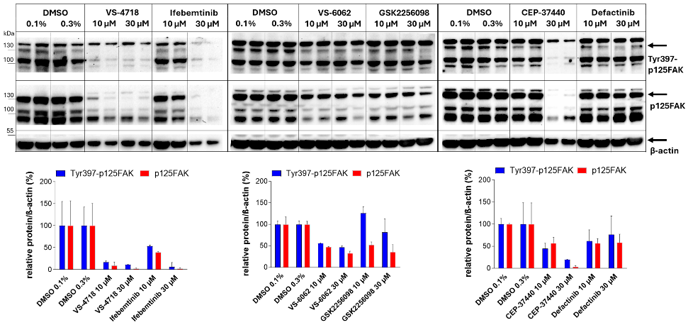
FAKi Induce Dephosphorylation at Tyr-397 of FAK in Pancreatic Tumor Cells
Pancreatic ductal adenocarcinoma (PDAC) is highly aggressive with a dense stroma and immunosuppressive tumor microenvironment. FAK inhibitors (FAKi) show promise in cancer treatment but have modest effects as monotherapy. Geisler et al. investigated the cytotoxicity of six FAKi on pancreatic tumor cell lines and explores their combination with the oncolytic virus CVB3 strain PD-H to enhance anti-tumor activity. To verify their functionality in pancreatic cancer cells, the Beta-TC-3 cell line was treated with 10 µM or 30 µM of different FAKi. After 24 hours, proteins were isolated and analyzed by Western blotting for levels of Tyr-397 phosphorylated FAK, total FAK, and β-actin (loading control). Results showed dephosphorylation of Tyr-397 when cells were treated with 10 µM FAKi, and more so with 30 µM. VS-4718, Ifebemtinib, and CEP-37440 were the most potent, while VS-6062 and Defactinib had moderate effects and GSK2256098 had minimal activity. Total FAK protein levels also decreased (Fig. 1). These findings confirm that all tested FAKi inhibit Tyr-397 phosphorylation in pancreatic tumor cells, with varying degrees of effectiveness.
Ask a Question
Write your own review
- You May Also Need
Description: Described as secreting a mouse monoclonal antibody (IgG2a) detecting all fibers in skeletal muscle and myosin heavy chains on Western blots and detecting mammalian, chicken, zebrafish, axolotl, ...
Description: Animals were immunized with the B6.1 mouse cytotoxic T cell line.
Description: neuroglial and neuronal character coexpressing ependymoma cell line.
Description: Established by irradiation of the adherent cells in long-term bone marrow cultures derived from C3H/HeNSlc strain mice
- Adipose Tissue-Derived Stem Cells
- Human Neurons
- Mouse Probe
- Whole Chromosome Painting Probes
- Hepatic Cells
- Renal Cells
- In Vitro ADME Kits
- Tissue Microarray
- Tissue Blocks
- Tissue Sections
- FFPE Cell Pellet
- Probe
- Centromere Probes
- Telomere Probes
- Satellite Enumeration Probes
- Subtelomere Specific Probes
- Bacterial Probes
- ISH/FISH Probes
- Exosome Isolation Kit
- Human Adult Stem Cells
- Mouse Stem Cells
- iPSCs
- Mouse Embryonic Stem Cells
- iPSC Differentiation Kits
- Mesenchymal Stem Cells
- Immortalized Human Cells
- Immortalized Murine Cells
- Cell Immortalization Kit
- Adipose Cells
- Cardiac Cells
- Dermal Cells
- Epidermal Cells
- Peripheral Blood Mononuclear Cells
- Umbilical Cord Cells
- Monkey Primary Cells
- Mouse Primary Cells
- Breast Tumor Cells
- Colorectal Tumor Cells
- Esophageal Tumor Cells
- Lung Tumor Cells
- Leukemia/Lymphoma/Myeloma Cells
- Ovarian Tumor Cells
- Pancreatic Tumor Cells
- Mouse Tumor Cells